
Dear Reader
“Unto the upright there ariseth light in the darkness; he is gracious, and full of compassion, and righteous.” (Psalm 112:4)
I was working at tearing off old siding on a Friday, and had banged myself up a few times, so I wasn’t surprised that I felt stiff and sore around my torso when I went to bed. The next day I worked at the remodeling again, and the soreness seemed a little worse. Then, the next day my wife looked at my back and told me there was a rash that looked like poison oak; there was a spot on my side and front like it. It didn’t make a lot of sense, though—it was beginning to feel like a bad burn (no itching), and it was all in places under my shirt, so I couldn’t see how I got all that exposure to poison oak without getting it on my hands or arms.
We thought through various theories, such as the possibility of an allergic reaction to something I had been working with, but in the meantime, the burning, aching feeling was getting worse, and I was having more trouble sleeping. We prayed, and asked the Lord for help to get good out of the trial and take care of the injured skin properly, and for an end to the trial as soon as possible.
Then Wednesday night came. I don’t remember experiencing such deep, aching pain in my life, and found my muscles tightening up until my head hurt, and the night was passing without any rest. I took a hot shower, and the pain subsided some, but still no sleep. My wife wasn’t getting any sleep either, and was getting a bad headache. We prayed earnestly for each other. A dog kept barking, and trains roared by. Finally, about 1:30 am, I got the heating pad and lay on it, and my body relaxed enough and the ache subsided enough for about a two hour stretch of sleep. The heating pad had almost given me a burn, and I took it off then. More prayers, the Lord took my wife’s headache away, and we both managed another hour or so of sleep.
During this battle, I had found myself praying earnestly for a man I knew who was trying to keep bread on the table for his family but had injured his back badly and was in constant pain. I also found myself praying more earnestly for many needs around.
The next day, we noticed the blistered areas were crusting up and the rash growing less, and thanked the Lord. My daughter prepared a plantain and aloe vera plaster, which my wife applied and wrapped me up in sterile gauze and bandages, and we looked forward to better sleep. It didn’t work out that way—the pain was less, but the sleep was less, too. The discomfort stayed just enough to keep me from sleep, and near midnight, I removed the bandages and gauze (it was rather binding). At that point, the overall discomfort was a little less, but still sleep would not come. I prayed, and again with a greater burden and compassion for those in constant discomfort, and finally came to a place of quietness and waiting upon the Lord. A little before dawn, I dropped into sleep for about an hour, and then got a couple more short naps in.
Then the Lord brought before me the scripture that is quoted above. The Lord prepares the upright for the work He gives him. This trial, this darkness, with light “arising”—slower than I’d like, after more suffering than I’d prefer—was illustrating to me the compassion, the patience, and the longsuffering God has in working with folks. The affliction is growing less (as of a week later), but much slower than I’d naturally like. In the ministry the Lord has called me to, there is great need for grace to overcome my natural desire to see and feel rapid progress, and for grace to continue bearing with problems I thought were already solved, but pop up again and again. There is graciousness and compassion and righteousness in the lives of those, who after the image of our Savior, have borne sorrow and suffering in serving the Father. I desire to gain the full benefits the Lord has for me in this trial.
I still don’t know where the affliction originated physically, but I know the wisdom of my Heavenly Father in permitting it and having my light “arise slowly.”
Love and prayers,
The Editor
About Us
We want to be of assistance to those who desire to live for God and make heaven their home, and we want to work with the Holy Spirit in stirring and awakening all others to the great necessity of doing so.
Foundation Truth is meant to be a family publication, with sections of particular interest to different members of the family, but we look to the Lord for direction on what to include, and the structure may vary from issue to issue.
We publish Foundation Truth by faith, its only support being free-will offerings that God lays on the hearts of His children to keep this ministry supplied. If the Lord lays it on your heart to contribute, please make out any checks or money orders to the editor, Richard Erickson—we have difficulty depositing any monies made out to Foundation Truth.
Address correspondence to:
Foundation Truth, email
Note that letters received may be considered for publication unless requested otherwise.
To make it easy for you to legally copy this magazine, we have licensed it under the Creative Commons Attribution License. Basically, you can copy any or all of this magazine, unless otherwise copyrighted, as long as you give credit and make clear our licensing terms.
From Streams in the Desert, Vol. 2, “December 10,”
by Mrs. Charles Cowman
“Be Careful for Nothing” (Philippians 4:6)
Do you cross rivers before you come to them, dread troubles that never come, expect evil from the Lord instead of good? In other words, is your soul full of unnecessary care? For that is what the word careful means—unnecessary care.
“Do not worry” is a plain and simple command, but it is such a difficult one to follow.
“There is nothing which we cannot pray about. Go deeper into the text: ‘But in every thing by prayer and supplication… let your requests be made known unto God.’ (Philippians 4:6) What we can take to God we can trust to God. What we put our fidelity into, He will perfect by His faithfulness. While we work for the best, He works the best for us. We may not succeed as we hoped; we may have discipline we little expected, but the Father knows what His child needs. What God has for us to do we can do, or to bear we can bear. Is there not enough in His ocean to fill our pitcher? With the need of every day will come His promised supply—‘My grace is sufficient for thee.’ (2 Corinthians 12:9)
“Do not forget the words further on in the text: ‘with thanksgiving.’ Be on the lookout for mercies. Blessings brighten when we count them. Out of the determination of the heart, the eyes see. If you want to be gloomy, there’s gloom enough to keep you glum; if you want to be glad, there’s gleam enough to keep you glad. Better lose count in enumerating your blessings than lose your blessings in telling your troubles.
“Unbraid the verse into three cords and bind yourself to God with them in trustful, prayerful, thankful bonds—Anxious for nothing, Prayerful for everything, Thankful for anything—‘And the peace of God, which passeth all understanding, shall keep your hearts and minds through Christ Jesus.’ (Philippians 4:7)” (Maltbie Babcock; Thoughts for Everyday Living)
The Word of Truth
“Study to shew thyself approved unto God, a workman that needeth not to be ashamed, rightly dividing the word of truth.” (2 Timothy 2:15)
Deceptive Influences
How can the devil have an advantage over a child of God?
In Sis. Mary Cole’s writings, she wrote, “At first Brother Warner was somewhat puzzled, as he could see that although some of us were affected by this false spirit, we still had the spirit of God…. I was still sitting in the congregation, knowing that I had some of the devil’s chattels on me.” How much can one have of the “devil’s chattels” and the Spirit of God at the same time? I understand about being in error and not knowing it, and that as long as one’s intentions are pure and for the glory of God, the Holy Ghost never leaves the person. Is this what is meant in the statements of Sis. Mary Cole? This is important where I see so much confusion and mixtures that are so difficult to sort out.
Reply:
I think that Sister Mary meant “collaterals,” but used the word “chattels.” That is, Satan had some advantage of her in believing something to be right when it wasn’t (the false gift of tongues). A picture of another sister under the same influence is pictured in Around Old Bethany. Note how the author describes the deceived sister as being under a terrific strain:
The scenes enacted at the meeting were well-nigh indescribable. Robert Davis attended one night, two weeks after the meeting had begun. He said to Mary when he got home, “Mary, I never saw such demonstrations in all my life before. Would you believe it if I should tell you that I stood in front of the front row of seats, about ten feet from the platform, and that I could not hear a word that those on the platform were singing? It is a fact. The altar extended between the seats and platform, and the seekers and those talking to them were making such a noise that the singing could no longer be heard.”
“Why did they make so much noise?” asked Mary.
“I do not know,” replied Robert, “They seemed very much in earnest. Let me tell you something more. I saw young women jiggle and jerk all over until their hair was all thrown down, and their clothing disarranged. Two or three men were running about on the platform as if they were mad; others danced more gracefully. One or two were bellowing. There were noises that were indescribable—screeches, howls, yells, and several gibbering syllables that no one understood. Some were shaking all over, some were lying prone and stiff, some were falling down into various attitudes. Why, Mary, it was simply awful! You would never dream of sane people doing such things.”
Next morning Kate Newby came over. She came in dancing and talking in the “unknown tongue.”
“Oh, I have got it, I have got it,” she exclaimed.
“You have got what?” asked Robert.
“I have got the Holy Ghost, I have the ‘tongues,’ hallelujah!” shouted Kate.
“What has it done for you?” asked Mary.
“Oh, I have got it, I’ve got it!” was all the reply Kate would make.
“Did you make a complete consecration to God? Did you seek Him for the cleansing power? Were you brought near to Him? Was your heart brought very humble and yielding to God? Tell me how you prayed, and what your faith took in,” said Robert.
“I have got it, I have got it,” was all Kate could say about her new experience. She seemed to be very happy, yet she looked as if she were in a tremendous strain, and lines were drawn in her face which denoted care and anxiety.
“My dear, did you come to the Lord for more of His grace?” asked Mary. “If so, we have a sure promise, but what is this ‘tongues’ that you have received?”
“That is proof that I have the Holy Ghost,” said Kate. “Don’t you know that the apostles spoke in tongues?” But Kate did not know the theology of the new religion very well.
[Robert L. Berry; Around Old Bethany]
Whenever Satan has an advantage over us, it produces some manifestation that is detrimental. The false thing overshadows our entire experience. Sometimes, a falsedoctrine can be very subtle in its harmful effect, but there is always something, for that poisonous effect is the whole point from Satan’s viewpoint. From God’s standpoint, it is a matter of free will choice. He knows whatever is there that mars the image of His Son. He knows that if I’m praying the prayer, “Cleanse Thou me from secret faults,” (Ps. 19:12) and really mean it, then I want help. But He also knows that I must see it to some extent, then voluntarily ask for help, in order that my right to choose be respected. This is one of the functions of our trials—the exposure of specific needs to take to God. They must be exposed to our eyes. “Search me, O God, and know my heart: try me, and know my thoughts: And see if there be any wicked way in me, and lead me in the way everlasting.” (Ps. 139:23-24) The searching and revealing is for my benefit, and we should not be discouraged, but trusting in our Perfecter. It all comes down to walking in the light that God sheds on our pathway.
Now to your question: “How much can one have of the ‘devil’s chattels’ and the Spirit of God at the same time?” It is rebellion on our part that breaks fellowship with God. Any knowing sin will break fellowship. That said, consider the degrees of fellowship a soul can have with its Creator. Perfect fellowship. Fellowship free from transgression. Choked fellowship (cares of this life). And finally, hindered fellowship, where a foreign influence strains the fellowship. Then there is broken fellowship, where fellowship has ended.
There is little question that Sister Mary Cole was hindered in her fellowship with God by the deception to which she had given place. I expect that her acceptance of the light on that particular subject was a great relief to her.
When I read Brother John Bunyan’s writings, I am mindful that there was an influence in his life that was not right (he was under the influence of a predestination doctrine that taught that God arbitrarily selected some men for salvation and some for damnation), and this influence had an effect on his vision. However, he loved God so truly and was so genuinely converted in his heart, that there is much of great value that he grasped and taught in his writings. The same is true of Jonathan Edwards. Sister Katherine Helm believed that the devil was in heaven and that there will be a thousand-year reign on earth with a literal kingdom. She mixed faith in God with faith in medical science, yet she dearly loved God and was filled with the Holy Ghost.
We might say that the marring effect of false teaching and less-than-sound doctrine varies, depending on how much the individual in question has imbibed, the virulence of the false things, and the strength of what is sound and true and present in the person. God goes by the motives and purposes of the heart, and the Spirit of God patiently works with each of us to lead us into all truth. We have fellowship with others as they walk in heaven’s light and vice-versa.
Holy Ghost Unity
How can we achieve Holy Ghost unity and destroy the sectarian walls?
While it is our duty to repove all outward sin, we must keep the fact prominent that all reform must begin at the heart, which God only can change; inward transformation is only upon the condition of faith, and, therefore, must be definitely presented in the Scriptural order of pardon and adoption to the sinner, and entire sanctification to the believer. We regret that some attempt to beat down the ice mountain of sect by the hammer of the Word, without the melting fire of the Holy Spirit. Getting people out of the sects any other way than by leading them to Christ for heart purity and the reception of the Comforter, which leads the soul from all sects and into all truth, is but enlisting men into carnal crusades against Babylon, and can result in little good, and has, in some instances, hedged up the way and turned back the tide of God’s truth more than it will be to advance it…. [T]he Bible experience of entire sanctification is the true objective of Christ’s atonement and shed blood, and… thorough holiness destroys sects and denominations, as frost would disappear under the beams of the June sun…. [T]he promotion of true holiness is the only remedy for schisms and every other form of sin in the body of professed Christians.
[Daniel S. Warner—quoted in Andrew L. Byers; Birth of a Reformation, “The Crisis”]
So many “Church of God(s)” and individuals claim to be carrying on the work along Bro. Warner’s vision. Yet, their dividing norms, catechism, and traditions contradict these statements of Bro. Warner. I feel that we should drop anything that we cannot directly read from the Bible and make efforts to come together along the principles of the statements above, leaving each individual to go on with their personal convictions without having to bind them upon others. Perhaps this will make room for the Holy Ghost unity and destroy the sectarian walls in the church of God as exists now. What do you say?
Reply:
I am thinking of Brother Orr’s statements in The Rule of a Saintly Life:
There is not enough living from the heart among the saints. There is too much coldness, formality, and dullness among us. This is a plain statement, but it is the fact. The reason why there is such formality and dullness is because there is not enough heart-living. There is too much doing and not doing because it is taught that we should do certain things and not do certain things. The things we do and do not do should be done from the power of a living “truth in the inward parts.” (Psalm 51:6) This only will save us from cold formality. If you were only able to receive it, I would say that too many are doing things merely because the Bible says so. Wait a moment, and let me explain. The Bible teaches (in principle) and preachers teach that it is distrusting God to take medicine. Now you can say, “I will not take any medicine because the Bible says God will heal all my diseases” [Psalm 103:3; Matthew 4:23])—and yet you may not be healed. Why is it? It is because you have not made that word you see on the printed page a living power in your heart. Jesus says, “If ye abide in me andmy words abide in you, ye shall ask what you will and it shall be done unto you.” (John 15:7) Multitudes are claiming that promise and getting no results. What is the trouble? It is because the word is not abiding in their heart in its power. Peter said, “Such as I have.” (Acts 3:6) He had something. He had healing truth as a power in his heart, and he gave it from himself to the man and he was instantly healed.
[Charles E. Orr; The Rule of a Saintly Life]
Brother Warner’s statements have validity only as they are taught in the scriptures; we might say that none of us are exempt from the Word of God. Wherever Brother Warner deviated from the Word of God, his teaching is not safe to follow or believe, and this is true of any of us, including me. “Be ye followers of me, even as I also am of Christ.” (1 Corinthians 11:1) A brother in Russia advocates that we should believe that the devil was once an angel in heaven; among other things, he produces written evidence that Brother Warner and other brethren once believed and taught this. However, the Word ofGod does not (although this man contends that it does). I must stay with the Word of God.
Nor do personal convictions prevail over the Word of God. This is the scriptural meaning of liberty of conscience—it applies only to things that the Word does not teach are right or wrong, such as eating of meat offered to idols. Even though a man may not have light on a certain Bible subject and actually be short of what the Bible teaches, his lack of light does not justify the thing. As soon as light comes to the man, he must change to obey or he will be in condemnation. “If I had not come and spoken unto them, they had not had sin: but now they have no cloak for their sin… If I had not done among them the works which none other man did, they had not had sin: but now have they both seen and hated both me and my Father.” (Jn. 15:22,24) It is not just respect for personal convictions without binding things on others that makes room for Holy Ghost unity and destroys sectarian walls; it is that respect coupled with God dealing with men and them measuring up to His light that produces real Holy Ghost unity. The attempts of men to straighten out men to some rule or creed simply polarize us and produce “I am of Paul” and “I am of Apollos”; and this simply reveals that more is needed from God, namely the removal of carnality (1 Corinthians 3:4). If we just say, “Well, I’ll try to put my arms around everything as long as I trust that the motives are pure,” then we will have a conglomeration, an aggregate association, that is a far cry from the unity we find in the New Testament. We must give others room to find Bible light through the dealings of the Holy Ghost, but true Bible unity is only found when the fundamentals (salvation from sin, entire sanctification through the coming of the Holy Ghost) are present and working in the heart of each believer and each believer is up-to-date in walking in the light from God. We must have the experience and the right attitude toward others, but there is no substitution for the work of God done in us. Two men filled with the Holy Ghost may differ about whether water baptism is necessary or how it should be done (immersion), but one or both are not led by the Holy Ghost and in God’s unity until they see and receive light and speak the same thing and have the same judgment. If they find themselves in disagreement, then there is nothing to do that will avail but take this to God and confess the reality of their need and ask that He make this plain to them. The overriding question is, “What is right?” This is our rallying cry, our humbling cry. “What does Jesus think?” “What would Jesus do?” As you told me many letters ago, “I just want to know.” I do, too. And we are both aware that when we “get it” from God, it will be the same. Now this process will make Holy Ghost unity and destroy sectarian walls utterly! Praise God! We must flow upwards, melted before Him by His fire (Micah 4:1).
I do not desire to “pull rank” on anybody, and I happily confess that I have no “rank” to pull. I will not conclude that I am “holier than thou” or superior in understanding, therefore I ought to prevail. I will, by the grace of God, stay in the light revealed to me and stay open to all other light. “Lord, I am open to everything that is of Thee, and closed to everything that is not.” And if I make mistakes in this, God is able to perfect and correct me, and I put my trust in Him that He will do just that. Nor do I need to compromise my light to accept others—I just leave it in the hands of Him who knows allthings. If something suddenly manifests itself in someone else or myself, I trust in God to deal with it and let me know what I should do or not do. Those who are too loose in this respect think I do not have enough love for others, and those who are strict beyond what the Spirit of God would teach, feel that I am a compromiser, but by the grace of God, dear brother, I will walk in the light as God shines it on my pathway. That is my privilege and my safety. In this matter, completely, I will let go and let God in all facets.
This is my privilege in confidence or lack thereof with respect to how people live, and this is my privilege with regard to what is taught. Here again, I must walk in the light and be faithful to what I have been taught by the Holy Ghost. I am looking for soundness in what is taught—the soundness that comes from the Holy Ghost. Not mere intellectual parallels with truth, but inspired, right-sound-of-the-trumpet truth, that proves itself by the fruit that it engenders, both that in opposition to it and in those who accept it. In short, the fingerprints of the Almighty in human beings. That is what I have to offer to others, too. My Lord said, “and that I do nothing of myself,” (John 8:28) and again, “the words that I speak unto you I speak not of myself: but the Father thatdwelleth in me, he doeth the works.” (John 14:10) And the testimony of Brother Paul, “yet of myself I will not glory, but in mine infirmities.” (2 Corinthians 12:5) All I have to offer to you, my dear brother, that is of any lasting merit, is the part that God has worked in me. All the rest is flesh and unworthy of our confidence.
The Appearance of Things
“…them which glory in appearance, and not in heart.” (2 Corinthians 5:12)
Is it better to look as if you are alive, or is it better to actually be alive? Is it better to look as if you are intelligent, or is it better to be intelligent? Is it better to give the appearance of a modest person, or is it better to actually be a modest person? Is it better to give the impression of a submissive wife, or is it better to actually have the inward victory that will enable you to live up to Sarah’s testimony to Abraham as recorded in 1 Peter 3:5-6? Is it better to give the outward impression that you dwell with your wife according to knowledge, or is it better for her and yourself to know that you love her equally as you love your own body? (Ephesians 5:28). To just look like you have the victory, or to actually have it, no matter how it appears?
We greatly fear that a good part of nominal Christianity is more the teaching of how to impersonate a Christian than insisting upon the actual possession of a triumphant, victorious experience in God. A religious experience toward men, instead of toward God. An emphasis upon the outward influencing of men (the art of the politician), rather than upon simply being genuinely spiritual, whether people accurately esteem you as a spiritual person, or not. We are surrounded by “Christians” that know how to talk the talk and how to imitate to a certain extent the walk, but upon closer examination, it is mostly, if not entirely, just a name to live while dead. This reflects the sad, unbelieving attitude of a certain skeptic: “Christianity is a wonderful idea—though it’s never been tried.” Perhaps this sad individual had never seen a genuine representative of pure religion and undefiled. Perhaps he had never seen anything but the pretended. He was certainly wrong in saying that Christianity has never been tried. It has been thoroughly tried and proven. It’s strongest testimonies come from its enemies. But we are sadly aware that the vast majority of Christian professions only bear out the skeptic’s conclusion. If there were nothing more to Christianity than what is commonly seen in the professors around us, then it would be worthless indeed, worthy only of scorn and ridicule.
The Bible tells us, “Let your light so shine before men, that they may see your good works, and glorify your Father which is in heaven.” (Matthew 5:16) Note the words, “so shine.” Not just shine, but so shine. Shine in a certain way that leads to authentic confidence, founded upon reality in such a way that men might glorify God. Not like the Pharisees, ““for they love to pray standing in the synagogues and in the corners of the streets, that they may be seen of men.” (Matthew 6:5) “Take heed that ye do not your alms before men, to be seen of them.” (Matthew 6:1) “But all their works they do for to be seen of men.” (Matthew 23:5) All of this was and is done in the name of influencing men for God, but what actually happens (when the influence actually works) is that it influences men for men. Many men are swayed by men—powerfully, thoroughly, but it has not the effect of glorifying the Father which is in heaven. The people in Samaria, from the greatest to the least, all thought that Simon was some great one and that he manifested the power of God (Acts 8:9-11), but the truth of the matter was that his heart was not right with God.
“The Lord said unto Samuel, Look not on his countenance, or on the height of his stature; because I have refused him: for the Lord seeth not as man seeth; for man looketh on the outward appearance, but the LORD looketh on the heart.” (1 Samuel 16:7)
It is the way of man to look on the outward appearance and to be impressed. Samuel, a true prophet of God, looked at Eliab… and he looked like a king. We are told of Samuel’s thoughts: “Surely the Lord’s anointed is before him.” (2 Samuel 16:6) You could not tell by looking. The outward appearance was not a good indicator of what the heart would do. It is a fact that people in themselves do not accurately evaluate God’s true little children. How could they? Consequently we read, “For I think that God hath set forth us the apostles last, as it were appointed to death: for we are made a spectacle unto the world, and to angels, and to men. We are fools for Christ’s sake, but ye are wise in Christ; we are weak, but ye are strong; ye are honourable, but we are despised. Even unto this present hour we both hunger, and thirst, and are naked, and are buffeted, and have no certain dwelling place; And labour, working with our own hands: being reviled, we bless; being persecuted, we suffer it: Being defamed, we entreat: we are made as the filth of the world, and are the offscouring of all things unto this day.” (1 Corinthians 4:9-13) The more we read in the New Testament of what God puts His children through, the more we realize that a child of God can only so shine by simply committing the whole thing into God’s hands. “I think that God hath set forth…” Here is the secret of the whole thing: be genuine without worrying about how you shine, and God will bring out the truth of what is there. He will appoint the trials and tests that bring to the view of all what is really there. A few will acknowledge it, but many will not. Most do not acknowledge it because it deals with them too closely. Some will not acknowledge it because their zeal for outward appearance devalues the need to be and exalts the need to appear. Such are those who “glory in appearance, and not in heart.”
Here is the key to how emotional, how physically demonstrative, a child of God should be: Bodily exercise profits very little, but godliness is profitable unto all things (1 Timothy 4:8). The brethren had a saying that captures the thought very well. “Jump as high as you like, but be certain you walk straight when you come down.” It is not wrong to be outwardly emotional or physically demonstrative, but the emphasis must be on what is behind all that outward stuff. This is to glory in heart.
If I glory in heart, I do not rejoice at the appearance of modestly-dressed people—I rejoice at the hidden heart modesty of the born again. Instead of glorying in the length of the skirt, the thoroughness of physical coverage, the appropriateness of fit, etc., I rejoice in the inward consideration of the saved for all men, including each other. For modesty is nothing more or less than a sober appraisal of the sexual attraction between human beings with a desire to be considerate and appropriate toward all. A woman should dress and act as a woman in a way that elevates and inspires a man toward appreciation of pure womanhood, and a man should dress and act as a man in a way that elevates and inspires a woman toward appreciation of pure manhood. Instead of rejoicing in just looking like modesty, I have the privilege of rejoicing in actual modesty from the heart. And if it is really there in the heart, it will manifest itself in the outward appearance.
There are people who dress outwardly in a way that clashes horribly with their inner condition of heart. It goes both ways. Some are dressing modestly who have little modesty inside, and there are a few who have found an inward modesty, but who have not yet borne the fruit that proceeds from the heart. There are wives that wear their hair long and even put an additional covering on their head, but their heart is not submissive to their husband. They have such faith in the outward appearance! As if the outward would lead the inward to victory. But the Bible tells us, “Keep thy heart with all diligence; for out of it are the issues of life.” (Proverbs 4:23) If you watch those who glory in appearance, you would think that this scripture should read, “Keep thy outward appearance with all diligence; for out of it are the issues of life,” but this is false. “Keep thy heart… out of it are the issues of life.”
You have taken a long step toward holy living when you have learned to do much and say little. Holiness is seen in what you do and not in what you say.
A man may discourse very beautifully about God and pray in public with great fervor and enthusiasm, but if he is negligent of secret prayer his religion is toward men and not toward God.
[Charles E. Orr; Helps to Holy Living, “More Holy Thoughts for Quiet Hours”]
“The Letter Killeth”
“Who also hath made us able ministers of the new testament; not of the letter, but of the spirit: for the letter killeth, but the spirit giveth life.” (2 Corinthians 3:6)
Many people take the letter and the spirit to mean opposing things. The meaning (and the spirit) of the text is revealed in stating it like this: “not of [just] the letter, but of the spirit: for [just] the letter killeth, but the spirit giveth life.” In other words, we are not to disregard the letter, but to realize that the letter by itself kills. Otherwise, we find ourselves on the grounds of a person who said, “Why don’t we just not pay attention to the Bible and just be led by the Spirit?”
The short answer to that question would be that God has appointed two witnesses, not just one, and that every commandment of His will is thus established in the mouth of those two witnesses, the Word of God and the Spirit of God.
Furthermore, we find in Zechariah 4 a description of their overall design and relationship to God’s children. The two witnesses are represented as two living olive trees, one on each side of a golden candlestick, and each tree continually emptying golden oil out of itself into the candlestick. It is plain that if the candlestick is too close to the Word, then the letter is not balanced by the spirit, and the effect is religious fanaticism, which kills. It is equally plain that if the candlestick is too close to the Spirit, then the spirit is not balanced by the letter, and the effect is religious zealousness, which leads to superstition and emotionalism.
If we attempt to define human love between two human beings in a code or creed (the letter), the reality of the two being in love is utterly lost—their love for each other will die in such an atmosphere. But if they attempt to follow complete liberty in the sense that they can do as they please (no letter), they will also lose their love for each other, for the spirit of love is more exacting, precise, and careful than any code or creed could possibly be. Here again, the letter killeth, but the spirit, invigorating and inspiring the letter, brings the most abundant, flourishing life that is possible.
Those who wish to have liberty to pick and choose among the teachings of the New Testament defend their actions by stating that they are avoiding the letter which killeth. Many of these are contending for liberties that Christ has not given them. Many are using the liberties granted by Christ for an occasion to the flesh, and they do this in the name of life, but it is a deception. Only the Spirit that inspired the letter can help us to properly interpret the nuances and details of that same letter in the way of life that enables the soul to exhibit the whole counsel of God.
“Every word Thy mouth hath spoken
Is essential to our life;
All Thy mandates love betoken,
To oppose them is but strife.
“Dear Redeemer, we would hallow
All Thy Word so firm and true;
In Thy footsteps meekly follow,
Thy commands we love to do.”*
Tell What He’s Done for You
Many Mercies
Recently our congregation had an experience where many of the Lord’s temporal mercies were displayed to us, and we want to relate at least some of it to the glory of God and the encouragement of His children.
A young married couple living in Canada had determined, for the sake of spiritual fellowship, to move here to be near the saints. The young brother is a Canadian citizen, and it took considerable heavenly-inspired courage and self-sacrifice to leave familiar surroundings and seek to emigrate to a new land, even though he had spent much time here over the years and his wife is from here. Besides the normal challenges involved in moving to a new home, there were the complications of unfamiliarity with “the way things work” under a different governmental structure and culture, the long, tortuous process of applying for a resident visa, how to move a household across international boundaries, and the difficult decision of how to go about finding work here, particularly in the throes of a severe economic downturn. For various reasons, spiritual and temporal, he quit his job there without any prospects yet here, trusting God to help him find work soon enough after moving here to meet his family’s needs. There is a great deal that could be shared about the helps the Lord gave through the process of applying (and waiting) for a visa that would allow him to work in the US, and other mercies the Lord showed in preparing them to move, but we will report on some of the mercies the Lord gave in the moving process itself, and in seeking work here.
At the time of the move, there were five adults, each driving a vehicle, and one child. One of the vehicles was an RV, and three vehicles were towing trailers. It was important for the caravan to proceed together through customs at the border, with a written list of the contents of each vehicle and trailer.
Their original hopes were to get to the border by 8 a.m., to avoid congestion at the border and get an early start on an almost 400 mile journey, avoiding rush hour traffic in Seattle and Portland.
Before the caravan had gone five miles, one vehicle and trailer got separated from the others. The driver did not have with him the cell phone number to contact the others, but he had left his cell phone number with one of the others just that morning. Just as they were separated, a tire on another trailer blew out, forcing the caravan to stop. At this point they noticed the absence and made contact and got reunited, as well as rearranging the load from one of the trailers which was turning out to be overloaded. What a mercy the absence was discovered before they were all waiting in line at the border crossing!
At the border crossing, the Canadian brother who was moving was informed that there was a bunch of paperwork that he needed to have with him to import his vehicle into the U.S., and he was taken into the office. It looked like he would be required to go back alone, obtain information from the manufacturer of his vehicle, and then return and try again. The saints were praying, and after 45 minutes or so the border officials, having done the research themselves on the vehicle, approved the vehicle for importing and let him go on!
By this time it was past 3 in the afternoon, and a sister driving one of the vehicles had a severe headache. There were still 350 miles to go, and rush hour in Seattle to face with all these heavily loaded vehicles to manage, and no extra drivers. They called for prayer, then stopped to rest for a couple of hours at a rest area. While most of them, including the sick sister, were resting in their vehicles, a brother who was resting outside by a tree had an unusual experience. A truck driver approached him hesitantly, seeming to need several attempts to get up the nerve to talk to him. He said to the brother that he hadn’t had an experience like this before, but felt that there was perhaps someone sick among their group that he was supposed to pray for. The brother explained about the sister with the headache, and the truck driver, being hesitant to disturb her in her rest, said he would go pray for her in his truck. After a little while passed, he drove off. The sister reported later to having begun to feel considerably better about that time, and able to rest better. When they resumed traveling, they were now late enough to avoid the rush hour traffic as well.
The driver following this sister (who was driving the RV) noticed several times during the evening near side-swipes and collisions between the RV and tractor-trailer rigs passing by. He recalls quite a few times of being in earnest prayer, including one time when a truck slammed on his brakes, narrowly averting a collision. God’s protection was very strongly evident!
The caravan arrived safely here after midnight, and the sick sister felt better after hours of fatiguing driving than when she left the rest area! Surely God was merciful and gracious!
Just after the trip, another of the Lord’s mercies was discovered. A new battery that had been put in the RV turned out to be a little too small, and the clamps had not properly held it in place. In the vibrations of traveling, the battery had moved and turned so that an engine belt pulley was constantly rubbing against it. The side of the battery where the belt rubbed was worn paper thin—if it had burst open during the trip, corrosive battery acid would have spilled over belts and hoses in the engine compartment, but in the Lord’s “just in time” plan, the wall held out and was discovered just in time.
I need to mention at this point that the weather had been quite wet, both in their starting point and their destination, for several weeks, but a dry spell began just before they needed to start loading up their vehicles, and continued until all the unloading into the house had been completed the evening after they returned. Then it rained harder than it had for several months!
So God graciously intervened on behalf of this move in many ways. But now the young brother was unemployed, and needing to find work to support his family and pay bills. He had moved to a state with the second highest unemployment rate in the whole country, and with the worst economic times in a generation! We all were looking to the Lord for mercy, and the Lord showed himself strong on our behalf. After about two weeks of searching, he was hired out of fifty applicants for a position with a locally based family-owned trucking company!
We present this testimony in thanksgiving to the Lord, and for His glory and the encouragement of His children.
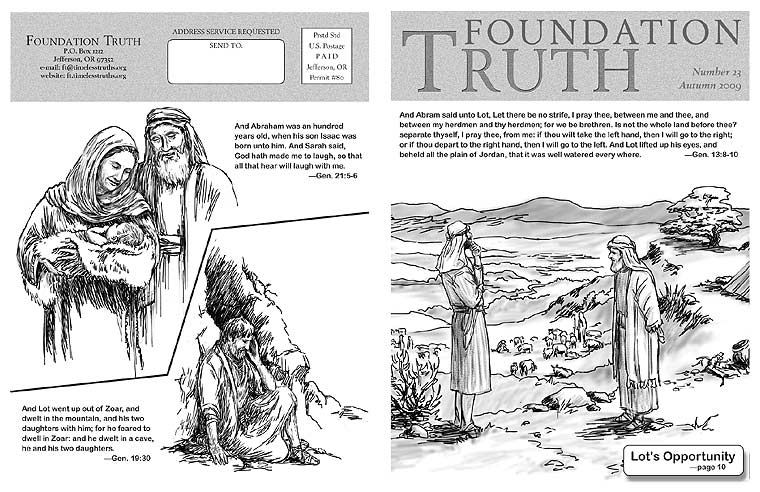
Lot’s Opportunity
“And Lot lifted up his eyes, and beheld all the plain of Jordan, that it was well watered every where, before the LORD destroyed Sodom and Gomorrah, even as the garden of the LORD, like the land of Egypt, as thou comest unto Zoar. Then Lot chose him all the plain of Jordan; and Lot journeyed east: and they separated themselves the one from the other. Abram dwelled in the land of Canaan, and Lot dwelled in the cities of the plain, and pitched his tent toward Sodom.” (Genesis 13:10-12)
This was one of the most significant steps of Lot’s life. He had not the slightest suspicion that this decision would lead to the destruction of all his family, except for two daughters, and that he would end up living in a cave, an unwitting participant in incest.
We find that Abram was a praying man (Genesis 13:4), but we have no record of Lot’s prayers. Lot looked and he chose; he leaned to his understanding (Proverbs 3:5-8), and the decision that he made seemed sensible and logical. Uncle Abram was generous and manifested no preference, so why shouldn’t Lot show his appreciation of his uncle’s magnanimity by choosing the easier path?
As with most lack-of-prayer-ers, Lot did not realize that Abram’s generosity came from his spiritual riches. For a man who prays can spiritually afford to be generous. He can afford to let others have the last word. He can afford to appear inferior in argument. Abram knew that God would take care of him regardless, so he could afford to be generous. How blessed to be spiritually rich! Both of these men were rich in this world’s goods, which (as always) left them with complications and challenges, but only one of them was spiritually rich. The other was spiritually poor.
Now if both had been spiritually poor, what a confrontation would have come out of this situation! “From whence come wars and fightings among you? come they not hence, even of your lusts that war in your members? Ye lust, and have not: ye kill, and desire to have, and cannot obtain: ye fight and war, yet ye have not, because ye ask not. Ye ask, and receive not, because ye ask amiss, that ye may consume it upon your lusts.” (James 4:1-3) Most of the trouble in the world stems from the spiritual poverty of men. Men feel they cannot afford to take the right way, the noble way. As one evil person said, “I can’t afford the luxury of a good conscience.” It isn’t a luxury—it’s a necessity. And one can afford it if one will really, really pray. There are sufficient riches in heaven for everyone (including Lot) to be spiritually wealthy and act accordingly.
What if both Lot and Abram had been praying men? There would have been no strain. Praise God! “Be kindly affectioned one to another with brotherly love; in honour preferring one another.” (Romans 12:10) It is very expensive to live “in honor preferring one another,” but there are riches in heaven for you to do so all the time toward everyone. “Is not the whole land before thee? separate thyself, I pray thee, from me: if thou wilt take the left hand, then I will go to the right; or if thou depart to the right hand, then I will go to the left.” (Genesis 13:9) Would it not have been wonderful if Lot could have replied, “It doesn’t matter to me, Uncle Abram. The will of God be done”?
“Oh, what peace we often forfeit,
Oh, what needless pain we bear,
All because we do not carry
Everything to God in prayer.”*
But Lot was not aware at all that he had forfeited peace and set himself up for pain with his decision. He did not even realize that he would end up in Sodom at that point. He was taking the first significant step toward a flood of vexation and remorse, but he knew it not.
“O Lord, I know that the way of man is not in himself: it is not in man that walketh to direct his steps.” (Jeremiah 10:23) How needful it is for us to pray and to get answers to our prayers!
God has not seen fit to inform us of a great deal of detail of Lot’s history. God tells us of the significant choice, and He tells us of two of the eventual, awful consequences, but the voice of inspiration is silent about what transpired in between. We read between the lines and are appalled.
“They separated themselves the one from the other.” (Genesis 13:11) This was not just the physical separation of going in two different geographical directions; it was a spiritual separation, too. When David came to a similar fork in the road, he said, “If I say, I will speak thus; behold, I should offend against the generation of thy children. When I thought to know this, it was too painful for me.” (Psalm 73:15-16) He was strongly tempted by the spirit of covetousness to be like the wicked, and opportunity to misuse what God had put in his hand was before him, just as King Saul had done before his eyes. But he also realized that if he yielded to that and lived that way, then he would break fellowship with all of God’s children who had lived right, and “it was too painful for me.” Of course, David only realized these consequences when he went into the sanctuary and saw the whole picture from God’s standpoint. This is what real prayer does for us. It helps us to think soberly (realistically) with God’s reality. It helps us to live up to Ecclesiastes 5:1-2.
But after a while, methinks that Lot began to realize that the separation from generous Uncle Abram was more than just living in the east while Abram stayed in the opposite direction. There were probably some family gatherings, and the differences in the lives of a praying man and his household were contrasted with the lives of a man who was not devoted to prayer. No doubt Lot comforted himself that he still held most, if not all, of the same values that he had held before, else how could Brother Peter speak of him as a just man and righteous (2 Peter 2:7-8). But could the same be said of Lot’s family, especially after his move to Sodom? Truly, the wily little foxes spoil the vines, especially the tender vines (Song 2:15).
We find Lot sitting in the gate of Sodom (Genesis 19:1). Adam Clarke comments on this, “Probably, in order to prevent unwary travelers from being entrapped by his wicked townsmen, he waited at the gate of the city to bring the strangers he might meet with to his own house, as well as to transact his own business. Or, as the gate was the place of judgment, he might have been sitting there as magistrate to hear and determine disputes.” We recognize the actions of a man under enormous strain. He is in a place where God did not put him, and he is in a battle with wrong that is not going to turn out well, for God did not send him there. He has suffered grievous loss, already, we find out, for his entire family is in a terrible condition. His son-in-laws are Sodomites; his two unmarried daughters are already mentally defiled by the wickedness in that place; and his wife’s heart is with her treasures in the abominable city.
He pleads with the two strangers to come to his house. Well he knows what will happen if they abide upon the streets. There is no decency left in his fellow citizens—only a hellish appetite that knows no restraint. But even Lot, with all the vexatious experience of dealing with these people to date, underestimates the strength of the constantly increasing wickedness in his fellow man. Soon, he is in a desperate strait. Had it not been for the supernatural intervention of the angels, he would certainly have been another victim of the Sodomites. Suddenly he is brought face to face with impending judgment upon the wicked people, long withheld, but now imminent; and he is told to get his family out of there immediately. No doubt he had tried to get them out before, but as the nature of the horrible wicked snare is newly manifested to his eyes, behold! O, the horror of that hour! There were things that held them fast, just as sin holds people today. And now, attended by two angels from God, he makes a last-ditch effort to persuade them to flee—but his corrupted family and in-laws merely laugh at his efforts and refuse to take him seriously. Only his wife and two unmarried daughters are disposed to humor the old man, and even then he cannot leave. “And while he lingered….” (Genesis 19:16) Oh, what terrible words! Impending judgment. Destruction at hand. While he lingered! And poor Lot cannot find strength to break away! Everything he had was invested in that place. Thus sin snares and entraps. It is a horrible and riveting thing to consider that Lot would have died in that place with the rest, had not “the men laid hold upon his hand, and upon the hand of his wife, and upon the hand of his two daughters; the Lord being merciful unto him: and they brought him forth, and set him without the city.” (Genesis 19:16)
Now it is a lot easier (hard as it was) to get out of Sodom than it is to get Sodom out of you. There were four of them who fled that wicked city that morning. Behind them, the first great hailstones of fire and brimstone exploded upon the rich, wicked city. The screams began—and were quickly silenced on this side of eternity—as the four terrified human beings ran for all they were worth. The angels’ admonition rang in their ears, “Escape for thy life; look not behind thee, neither stay thou in all the plain; escape to the mountain, lest thou be consumed.” (Genesis 19:17) An overwhelming compulsion to see if anything was left came upon Lot’s wife. “Just a quick glance,” she thought. It cost her life. We are told to remember that look (Luke 17:32). Now there were but three. The wretched man asked if Zoar might be a refuge. “It is a little one: Oh, let me escape thither, (is it not a little one?).” (Genesis 19:20) The man who had chosen the most promising, the biggest, the wealthiest prospects of all was reduced to begging for a little town. His plea was accepted, but in the end, he was too scared to stay there, either. He ended up in the mountains, in a cave, with his two wicked daughters, and there he was deceived by them, brought to immorality, and had to live with the consequences. Surely the waters of a full cup were wrung out to him!
The separation between himself and Uncle Abram had assumed calamitous proportions. How could he go back now? His lack of praying had cost him everything worthwhile.
“But the natural man receiveth not the things of the Spirit of God: for they are foolishness unto him: neither can he know them, because they are spiritually discerned.” (1 Corinthians 2:14) It is just plain foolhardy, dangerous beyond the telling, to just run around thinking your own thoughts, doing as seems best to you, being guided by something other than the Holy Ghost. For surely, if we are not led by the Holy Spirit, we are going to be led by something. The enemy of our soul finds his prey in those who live in this way, and he is not much hindered by right conditioning or right background or correct teaching. Satan goes about as a roaring lion, seeking whom he may devour, and if you are living as Lot lived, you are one of the ones who will most certainly be consumed. You need to pray. You need to forsake your way and mortify (put to death) your members on the earth, that the will of God be done in you instead of your own will.
“Save yourselves from this untoward generation.” (Acts 2:40)
Editor’s Note: In relation to the previous article, we have adapted some recent correspondence regarding Lot’s spiritual condition.
Objection:
“And if he rescued righteous Lot, oppressed by the sensual conduct of unprincipled men (for by what he saw and heard that righteous man, while living among them, felt his righteous soul tormented day after day by their lawless deeds)….” (2 Peter 2:7-8)NASB
The inspired scripture above refers three times to Lot as righteous: “righteous Lot,” “righteous man,” and “righteous soul.” This seems to contradict the tone of the article.
Response:
“For I say unto you, That except your righteousness shall exceed the righteousness of the scribes and Pharisees, ye shall in no case enter into the kingdom of heaven.” (Matthew 5:20)
“God, I thank thee, that I am not as other men are, extortioners, unjust, adulterers, or even as this publican. I fast twice in the week, I give tithes of all that I possess.” (Luke 18:11-12)
“By faith Noah, being warned of God of things not seen as yet, moved with fear, prepared an ark to the saving of his house; by the which he condemned the world, and became heir of the righteousness which is by faith.” (Hebrews 11:7)
Note that Noah did not have that particular righteousness which is by faith, but in the righteousness he did have, he became heir to it. This conclusion is in agreement with Hebrews 11:13, which tells us that these died “in faith, not having received the promises, but having seen them afar off, and were persuaded of them, and embraced them.”
“Beloved, now are we the sons of God, and it doth not yet appear what we shall be: but we know that, when he shall appear, we shall be like him; for we shall see him as he is. And every man that hath this hope in him purifieth himself, even as he is pure.” (1 John 3:2-3)
“Little children, let no man deceive you: he that doeth righteousness is righteous, even as he is righteous.” (1 John 3:7)
When men receive of the righteousness of God, and the righteous acts of their lives proceed from this righteousness principle put by grace within their moral nature, that righteousness and its fruits are exactly the same as was in Jesus. With respect to this particular kind of righteousness, before the gospel, we read, “As it is written, There is none righteous, no, not one.” (Romans 3:10)
The superior quality of the righteousness which is in Christ is referenced in verses 21 and 22.
Beyond any doubt, Peter was not speaking of Lot being righteous in this New Testament sense. He was speaking of Lot being righteous in another sense. No New Testament child of God could have offered his two virgin daughters to the Sodomite mob. “Whosoever is born of God doth not commit sin; for his seed remaineth in him: and he cannot sin, because he is born of God.” (1 John 3:9) As we read of Lot’s actions, if we possess a purified moral nature, we are horrified at his words. “How could he do that?” we wonder. His righteousness was of another kind than the New Testament righteousness we possess.
Now, the question: Was the righteousness of Lot acceptable enough to God for him to go to heaven?
That question raises a host of questions. Was Lot’s wife righteous as he was? She turned into a pillar of salt. Yet she was one of the ones compelled to leave the city of destruction in answer to the intercessory prayer of Abraham. How about his daughters? By their actions later, absolutely not. How about Lot’s intoxication and the awful results? How about the condition of his heart as portrayed by his lingering, his inability to leave his family and possessions in Sodom?
Beyond any doubt, Peter’s words were fulfilled in Lot’s abhorrence of the sin around him. With respect to the awful wickedness about him, Lot was a just man, a righteous man. With respect to deliverance from covetousness, I am not so sure that Lot was righteous. I note that God did not lead him to Sodom; in fact, Lot seems to have been on his own after the significant choice of which direction to live. Again, a clear difference from the New Testament (Romans 8:14). With respect to the young man who came running to Jesus and fell at His feet, crying, “What lack I yet?” (Matthew 19:20) Lot lacked things yet, too—things that would make him righteous. Again, the question: What was the standard of being acceptable to God before the Mosaic Law, before the gospel?
There is little reason to doubt that Lot was sinful. He was not rescued from the sin of abiding and being a part (howbeit a reluctant, a vexed, a tormented part) of Sodom. He was not rescued from the sin of going there; he pitched his tents toward Sodom. He was rescued from the destruction of the city, but it could be well said that he was not godly, nor delivered from temptation. Note how he lingered. As we consider the life afterwards of this wretched man, father to each daughter’s child, it is well nigh impossible to consider the fruits of his life and think, “a godly man,” “a righteousness man,” and enjoying the fruits of that righteousness. What an awful contrast with the later life of Abraham! It is exceedingly difficult to think of Lot entering heaven, but it is not difficult to think of Abraham in this way.
I will quote a little from Salvation: Present, Perfect, Now or Never:
“And to you who are troubled rest with us, when the Lord Jesus shall be revealed from heaven with his mighty angels, in flaming fire taking vengeance on them that know not God, and that obey not the gospel of our Lord Jesus Christ: who shall be punished with everlasting destruction from the presence of the Lord, and from the glory of his power.” (2 Thessalonians 1:7-9)
At the same time we are told that He will “be glorified in his saints, and admired in all them that believe.” (2 Thessalonians 1:10) So let it be known once for all that all who are unfit for heaven will be driven back to hell “from the presence of the Lord, and from the glory of his power.” Though heaven’s gates stand wide open before all men, no person will enter with a stain of sin upon his soul. No unholy man can endure the presence of God and his divine glory. The hottest place in hell was a relief to the soul unsaved and out of Christ.
A wit once said in a New York paper that he dreamed a certain man, prominent in his circle, had died, and approached the gates of heaven, where he was told, “YOU MAY COME IN BUT YOU WILL NOT LIKE IT.” A mighty truth was unwittingly uttered by the thoughtless sinner. Oh, that the Almighty may make men to consider that heaven is worse than hell itself for all who are not of heavenly temper! Oh, how sad and sickening the sight of our present evil world, and its awful destiny so near! The masses who profess the Christian name, know they are sinful and unholy, and yet hope to stop sinning when safe in heaven. We used to hear them sing with much animation,
“If I only get to heaven,
If I only get to heaven,
If I only get to heaven when I die.”They hope to see the beautiful gate ajar for them, and if they may only be permitted to slip into the golden city, imagine they will be all right. Oh, how awful will be their disappointment! The very holiness of heaven will drive them back in terror. Jesus knew very well that men would base their eternal happiness on merely getting into heaven, and has given us a parable to show all men how such a faith will terminate. He tells of one who came in without the “wedding garment”; but he did not enjoy it. He was speechless, and was bound hand and foot, and cast out into outer darkness; “there shall be weeping and gnashing of teeth.” (Matthew 22:1113) Nothing but the spotless robe of perfect holiness will make heaven a heaven for you.
“Be not deceived, God is not mocked.” (Galatians 6:7) None but the pure in heart can enter there and see God in peace. Yea, in the light of God’s truth we cry aloud and say unto all, you must be as pure as heaven to enter and enjoy that holy place. And, thanks be to the God of all grace and mercy, SALVATION will put you in that condition and preserve you ready to enter and enjoy all the glory of heaven. Many scriptures prove the fact. “For by one offering he [Christ] hath perfected for ever them that are sanctified.” (Hebrews 10:14) This does not mean that the holy state cannot be forfeited; but that entire sanctification perfects our salvation from sin, and puts us on the plane of heaven’s purity. Therefore Christ, “being made perfect [a perfect Savior]… became the author of eternal salvation unto all them that obey him.” (Hebrews 5:9) The law was a temporary system; it “made nothing perfect, but the bringing in of a better hope [Christ] did.” (Hebrews 7:19) In him we have come to the final and complete redemption, that fits us for the society of God through all remaining time and eternity.
“And the very God of peace sanctify you wholly; and I pray God your whole spirit and soul and body be preserved blameless unto the coming of our Lord Jesus Christ. Faithful is he that calleth you, who also will do it.” (1 Thessalonians 5:23-24)
[Daniel S. Warner; Salvation: Present, Perfect, Now or Never, “Salvation Fits Us for Heaven”]
Jacob lived a life of less than New Testament holiness, too. His testimony was, “Few and evil have the days of the years of my life been, and have not attained unto the days of the years of the life of my fathers in the days of their pilgrimage.” (Genesis 47:9) Yet we believe that he was accepted of God and made it into paradise.
The same could be said of all children of God prior to the New Testament. “And the times of this ignorance God winked at; but now commandeth all men every where to repent.” (Acts 17:30) While this scripture is specifically addressing idolatry, yet, in a general sense, it applies to a multitude of sins that God overlooked to an extent before the time of deliverance in Christ. If David had died during the year after he had Uriah murdered, after he had committed adultery with Bathsheba, when he was being the hypocrite, would he have gone to heaven? When he humbled himself and confessed, “I have sinned,” (2 Samuel 12:13) he found forgiveness, but what would have been his end if he had not?
It is quite possible that Lot could have been a righteous man in many respects, but not in others, in such a way that he would not have been acceptable to God in the end. Peter did not say (by inspiration) that Lot was heaven-ready righteous. The scope of the words, just and righteous, do not necessarily mean heaven-ready. They mean just what they say: Lot was right in his stand against the evil of Sodom. He was just in that respect, and perhaps with only that scope of meaning.
Objection:
Peter by the Spirit used Lot as an example of how God knows how to rescue the godly from temptation (“…if He rescued righteous Lot… then the Lord knows how to rescue the godly from temptation…” (2 Peter 2:7,9)). I would hardly think Peter by the Spirit is going to use a lost person as an example of how the Lord can rescue godly people.
Response:
There is no doubt whatsoever that Lot was delivered from Sodom. There is also no doubt that he would never have gotten out on his own. Sodom had him. Except those angels had taken him by the hand, the Lord having mercy on him, he would never have made it out. Nor is there any doubt that we could ever successfully resist all the cunning and ingenious temptations devised for each of us by the master of evil if God did not have mercy on us and help us, too. No man under grace has ever lived a holy life without God’s help, any more than Lot was able to extricate himself by his own will. It is in this way and with this scope of understanding that Peter by the Spirit speaks of Lot’s situation. Still, by any measure, Lot’s life was a failure—a huge, awful failure—a disgrace and a terrible warning. The Bible says, “Remember Lot’s wife,” (Luke 17:32) and we would do well to “Remember Lot,” too. As is true of many less-than-acceptable-to-God lives, he could say to us, “Don’t do as I have done. Don’t live so that you must be rescued by an angel from the city of destruction, and your whole life is a waste, your family is wrecked and ruined, and you finish out your days as an example of what sin can do to you.”
Even this does not mean that Lot missed heaven. “Every man’s work shall be made manifest: for the day shall declare it, because it shall be revealed by fire; and the fire shall try every man’s work of what sort it is. If any man’s work abide which he hath built thereupon, he shall receive a reward. If any man’s work shall be burned, he shall suffer loss: but he himself shall be saved; yet so as by fire.” (1 Corinthians 3:13-15)
Alone with Jesus (Naylor)
 Higher Ground
The Baptism of John
Was It of Heaven or Was It of Men?
“Behold, I will send you Elijah the prophet before the coming of the great and dreadful day of the Lord: And he shall turn the heart of the fathers to the children, and the heart of the children to their fathers, lest I come and smite the earth with a curse.” (Malachi 4:56)
There was a group of Jews who really took these scriptures to heart. They were very careful people. They were so cautious! Not only did they reverence this prophecy in Malachi, they watched diligently for its fulfillment. And as they watched, they imagined and speculated. “The great and dreadful day of the Lord would be spectacular indeed!” they thought. And in due time, they added to the words of the scriptures their own particular set of expectations, and they distinguished not between their own ideas and the promise of God. This was not done deliberately. In fact, they did not know that they were doing it. The problem was that they were on their own, even while blindly trusting that they were not on their own, and their hearts were not taught of God. In this, of course, they were exactly like many careful people today. The closest examination would find no fault in their sincerity according to their own thinking.
We are told how they noticed the ministry of John the Baptist and how they questioned him.
“And this is the record of John, when the Jews sent priests and Levites from Jerusalem to ask him, Who art thou? And he confessed, and denied not; but confessed, I am not the Christ. And they asked him, What then? Art thou Elias? And he saith, I am not. Art thou that prophet? And he answered, No. Then said they unto him, Who art thou? that we may give an answer to them that sent us. What sayest thou of thyself? He said, I am the voice of one crying in the wilderness, Make straight the way of the Lord, as said the prophet Esaias. And they which were sent were of the Pharisees.” (John 1:19-24)
You can see what a thorough, careful investigation they made. “Are you the Anointed [Christ]?” No. “Are you Elijah?” No. “Are you that prophet?” (Deuteronomy 18:15,18) [“The Jews had a tradition that Jeremiah was to return to life, and restore the pot of manna, the ark of the covenant, etc., which he had hidden that the Babylonians might not get them. Besides this, they had a general expectation that all the prophets should come to life in the days of the Messiah.”—Adam Clarke’s Commentary]) After this investigation, they figured they were safe in rejecting this ministry. Had they not asked the right questions? Did not John reply “no” to each? “Evidently,” they thought, “this man just had some ideas, such as baptizing Jews who repented, which were not according to the Law of Moses or the traditions of the fathers, the Talmud.” According to their tradition, this latter (the Talmud) was the oral law, and the written Law of Moses and the oral traditions were regarded with equal value in their minds. “Should he and his ideas be accepted as part of the truth?” they thought. “Only if he were Christ, Elijah, or That Prophet!” And he said that he wasn’t.
Only he was Elijah! Not actually, of course. The real Elijah was enjoying his rest in Paradise. Shortly after, he came and conferred with Jesus and Moses on the Mount of Transfiguration (Matthew 17:3) and went back to Paradise. He and Moses are still there, resting from their labors, and awaiting the end of time and the general judgment. But it was said of John the Baptist, “And he shall go before him in the spirit and power of Elias, to turn the hearts of the fathers to the children, and the disobedient to the wisdom of the just; to make ready a people prepared for the Lord.” (Luke 1:17)
After that experience on the Mount of Transfiguration, “his disciples asked him, saying, Why then say the scribes that Elias must first come? And Jesus answered and said unto them, Elias truly shall first come, and restore all things. But I say unto you, That Elias is come already, and they knew him not, but have done unto him whatsoever they listed. Likewise shall also the Son of man suffer of them. Then the disciples understood that he spake unto them of John the Baptist.” (Matthew 17:10-13)
Is this not amazing? The work of God was accomplished under the very noses of those who had appointed themselves to watch for it, but “they knew him not.” Thus it has always been, and thus it will always be, “because the foolishness of God is wiser than men; and the weakness of God is stronger than men.” (1 Corinthians 1:25) The poor, the common, the publicans, the harlots, and the soldiers were able to get help from the God-sent ministry of the new Elijah, John the Baptist, but the defenders of the truth, the watchful, the so careful, those who sat in Moses’ seat, they missed it entirely. What a lesson for you and me!
“And in them is fulfilled the prophecy of Esaias, which saith, By hearing ye shall hear, and shall not understand; and seeing ye shall see, and shall not perceive: For this people’s heart is waxed gross, and their ears are dull of hearing, and their eyes they have closed; lest at any time they should see with their eyes and hear with their ears, and should understand with their heart, and should be converted, and I should heal them.” (Matthew 13:14-15)
Thus it is with many in positions of authority and influence in the “Church-of-God” sects of today (and other parts of Babylon, too). The hearts and minds of those whom you might least suspect have waxed gross, and their eyes are closed, too. They are so busy “defending and upholding” their idea of the truth, that they are amazingly unconscious of the true work of God. They just won’t accept it unless it fits with their conception of truth. Mostly whether or not it fits or could fit into their church and their creed. Would their people accept it? It is either too strict or not strict enough. A work must fit into their creed to be accepted. They are as the congregation described in Revelation 3:17, “Thou sayest, I am rich, and increased with goods, and have need of nothing; and knowest not that thou art wretched, and miserable, and poor, and blind, and naked.”
“The baptism of John, whence was it? from heaven, or of men? And they reasoned with themselves, saying, If we shall say, From heaven; he will say unto us, Why did ye not then believe him? But if we shall say, Of men; we fear the people; for all hold John as a prophet.” (Matthew 21:25-26)
The only difference in what is described in this scripture and what we have today is that most of these blind leaders of the blind are not under the public pressure that the Pharisees and scribes experienced. So they readily dismiss the different works of God around them without ever really addressing the vitally important question, “Whence was it? from heaven, or of men?” Reader, your dwelling place in eternity depends on the answer of your heart and life.
Abridged from Only a Servant, by Kristina Roy
“The Son of man came not to be ministered unto, but to minister.” (Matthew 20:28; Mark 10:45)
Only a Servant
Part One
The New Servant
Just when farmer Ondrasik needed help most and had no idea where to find someone, there came to his house a man, uninvited and unexpected.
It was on a Sunday evening in the middle of the harvest. Ondrasik sat under the fruit tree in front of the house, resting his head, heavy with care, in the palms of his hands. Suddenly, in the yard the dog, Fidel, began barking, and before the careworn husbandman stood a young, healthy man, decently clothed. After an exchange of greeting, he said that he was looking for work.
Ondrasik was not one of those who would take just anyone at once to work for him; but this young man somehow appealed to him, and he needed a laborer urgently. His wife was sick in bed. His sons-in-law had left him—one last year, the other in the spring—to go to America, and their wives followed them; thus only the youngest daughter, about sixteen years old, remained with him at home. He had a cow boy, Andrew, but he had been badly beaten up in a fight with some other fellows, and was lying ill at his mother’s home, and a laborer was nowhere to be found. Therefore Ondrasik accepted this young fellow. “Anyway,” he thought, “it will not cost me anything to try him; I will take him at least until Andrew gets well.” The daily pay that he was to get during the threshing season was agreed upon.
Ondrasik slept better that night than he had for a long time; and his wife, though she could not sleep, at least did not have to worry about how her husband would manage with all the work.
The Ondrasiks were quite satisfied with the new laborer, except for his curious name. He was called Methodius Ruzansky. It was the name of the former apostle to the Slovaks, who used to live in Nitra, where he preached the Word of God to the people. The farmers did not usually give their sons such names. Occasionally one of the Catholics did, but Ondrasik was an Evangelical.
But people will get used to most anything. The general consensus among the people was: “Ondrasik got hold of a good laborer!”
And how good a one, Ondrasik knew better than anyone else. This one did not drink; therefore, he would not be fighting with the other fellows. He did not smoke; therefore, there was no danger of setting fire to the barn. During the week he worked from morning till night, while Sundays he spent reading. He did not use bad language and was always good humored. When Dorka, the daughter, spoiled some food and her father was angry, he excused her and praised it.
All this pleased the Ondrasiks very much, and therefore, they arranged with him to take him as a full-time servant, starting in November.
“Very well,” agreed Methodius, “I will stay with you and serve you, if you will take me for a term of two years, and permit me to fix myself a room above the workshop.” The farmer wondered what kind of a living room that would be.
“You will agree with me that it will be good. And whatever I shall spend on it, if it pleases you, and you can make use of it, when I shall leave you can repay me my cost. If it does not suit you, I shall take it apart and sell the materials.”
Ondrasik agreed readily, and as soon as the rainy days came, Methodius brought in some boards and spent only two days, besides doing the regular chores, to build up his room. When it was finished, he brought in the farmer and his daughter to see it. Ondrasik laughed.
“Just look what a fine room he will have, better than ours! And how will you manage in the wintertime?”
“I can sleep just as well in a cold room, and during the day you will surely allow me to warm myself.”
From the remaining boards Methodius made himself a small table, a cupboard in the corner, and a clothes closet. The bed and chair he bought ready made. The room was surprisingly cozy; especially when later he built in dormer windows, which gave him a beautiful view of the fields and meadows round about, the woods beyond, and the sometimes beautiful sky, now often obscured with the fog and clouds of the fall.
The Petrash family were the nearest neighbors to the Ondrasiks. They had a son twenty years old, a good looking and decent young man, but he was lame. Therefore, though they were a fairly well-to-do family, he could neither read nor write. He moved slowly about the house, attending here and there to a little matter, but was not able to go farther about.
Mrs. Petrash loved her Sammy above all her children. His father was not very good to him; he was displeased that such a big son was of no use in the house and that he would always be a burden.
If it had not been for the mother’s love, the young fellow would have fared rather badly in his parental home. A dreary future lay before him. And, as usual, in such a case, those who are not able to move freely want to achieve great things in this world. Thus he also had great plans.
One Sunday afternoon, as he was sitting all alone, lost in thought, his head resting on the palms of his hands, suddenly the servant of his neighbor stopped before him, holding some kind of a book.
A mingled feeling of sadness and jealousy gripped the young fellow. “He is only a servant and knows how to read, and I am so ignorant.” He barely responded to the friendly greeting.
“Since you are sitting here all alone, surely the time must be very long for you,” spoke Methodius. “Therefore, I brought you a book.”
Sammy blushed deeply. “What good is a book to me, not knowing a single letter?” he frowned.
“Forgive me, I did not know,” kindly answered the servant. “It being thus, if you please, I will stay with you and we shall read together.”
Thus began the acquaintance of the new neighbors.
Leaning on the fence of the Petrash property was the hut of the Jew, David. Now he lived there all alone. He had two goats and spent the whole day taking care of them; and when he had no work with the goats, he was sorting old rags and bones and whatever else the housewives brought to him. He traded them for threads and needles. In his younger days he followed this business in all the surrounding territory, but now went only as far as was necessary for the care of the goats.
No one remembers ever having seen old David smile; otherwise, he was a kind, gentle man. Many were the wrongs he had to suffer, but he bore them all quietly.
It was commonly known that he had a wife in his youth, before he came to the village Hradova, and that somebody took her away from him. Who knows whether it was true or not?
The neighbor on the upper side of the Ondrasik property was a shoemaker, by the name of Martin Podhajsky. This neighbor caused a great deal of annoyance, because he was such a drunkard, that everybody preferred to keep out of his way. Only his mother lived with him; his wife, when she could stand it no longer, preferred to work as a servant for strangers and was sending clothing and shoes for the children, because otherwise they would have to freeze in winter. She also sent something to her mother-in-law for taking care of the children, and in the beginning, also some shirts to her husband at times. Since he wasted all, she was disgusted and stopped sending them.
Methodius once found him lying in a mud puddle dead drunk, just about to suffocate. His mouth, nose and ears were full of mud, and it was a hard job to pull him out. Just then a Gypsy passed by, and Methodius asked him to help.
They carried the wretched drunkard into the workshop of Ondrasik and laid him on the straw. Methodius warmed some water and washed him thoroughly—excuse the comparison—like a pig when it is already in the trough. In the beginning the drunkard tried to resist, but by and by he sobered up and stopped cursing; and when Methodius also cut his hair, shaved him, and cut his long fingernails, he appreciated it.
From that time on, the servant of Ondrasik had a great influence over the unfortunate drunkard and could do with him what he wanted. He gave him an order for a pair of shoes, and Podhajsky had to promise that he would not drink before he finished that pair of shoes, and he kept his promise. To help him pass the long evenings, Methodius visited him and read to him from the books of his mother, the Bible and the song book, and out of newspapers which he brought with him. Since it was now November, the farmers did not have much to do in the evenings. Thus Methodius read out of these newspapers at home, to the landlady, “Gazdina,” and her daughter. Even Andrew loved to listen. Ondrasik was very glad that his servant took a newspaper. It was a very good newspaper; it gave lessons about the Scriptures, as well as information about things happening in the world.
One evening just as they were reading, Podhajsky brought the boots. He was not drunk. They invited him to sit down. Since that time Methodius did not go to Podhajsky to read, but he came to the Ondrasik’s, and they were all benefited by it. In the twilight before supper, Methodius used to go to the neighbor, Petrash. It soon was known among the women that he was teaching Sammy to read. Once he asked if he could bring Sammy to their house.
“And why could you not?” agreed the landlady. “The time will pass better for the poor fellow.”
In this manner, during the long winter evenings, the time passed very beautifully. They stripped a lot of feathers for featherbeds. Andrew, the cow boy, did not run around with the other fellows any more; Ondrasik also stopped going to the dram shop, and instead whittled wooden implements, and taught Sammy also.
Once, while they were thus sitting, Dorka mentioned that old David was ill and that it must be cold in his hut. Who knew if he had anything with which to make a fire? That evening Methodius just finished reading a book, told them “good night,” and went away.
“Just watch and see—he will go to that Jew,” said Andrew.
“He is a strange kind of a fellow. Nobody is too repulsive for him to help,” sighed Podhajsky, who was also present.
Thus the spring came before the people realized it.
One Sunday Ondrasik and his servant were standing at the end of the orchard. In front of them lay swamp and beyond that a hill, sparsely overgrown with grass and a few bushes.
“Listen, boss,” said Methodius, “this is a disgrace to your whole prosperity. Why don’t you buy this hill from the community?”
“I? What good would it be to me?” The farmer wondered that his sensible servant could think and say something like that.
“Well, that hill could be leveled. Out of the clay you could make good bricks and with the balance fill in this swamp.”
“I don’t need any bricks and I also have sufficient land. What would I do with that hillock?”
“I’ll tell you what to do: you buy it for me, but in your name, and I will then buy it from you. I like it very much here. I have a few hundred dollars in cash, and in the two years I will gradually build me a hut and will be your neighbor.”
Ondrasik smiled at what he thought was a joke. But it was no joke; Methodius gave him no peace until his master was favorably inclined. Thus Ondrasik bought and sold to his servant the hillock and the swamp. They made an agreement—as long as there would not be much hard work, he could use three hours, and when the work started he could use two hours a day to work his own land.
Well, when the planting was finished, Methodius said, “Listen, master, for two or three weeks, we shall not have much work to do: let Andrew and me work these weeks on my property, and I will work for you only a quarter of a year only for my food. Will you agree to that?”
“Well, I don’t care; I will even help you myself, because I would like to see just what you will achieve. But if you have some ready money, you should buy a hut for yourself somewhere.”
“But that would be only a hut, and I shall have a house!” laughed the young fellow. “You will see that my God, in whom I trust, will help me.”
Even the neighbors used to come to see what Ondrasik’s servant was doing. He hired Podhajsky and his mother. Besides these, he and Andrew, and off and on, Dorka, and even the master himself, helped to dig on the hillock and fill in the swamp. They dug down so much soil that the swamp was not only filled, but even raised above the level of the road and leveled off like a garden.
Methodius bought some dwarf fruit trees in a nursery and planted three nice rows, and to the wonder of all, when the summer came, it was seen that all took root. Afterwards they began to make bricks, and when the urgent work called the others away, Podhajsky stayed and continued until the time of harvest.
“Who could have told that Ondrasik’s servant would give us such an opportunity to earn something!” said Mother Podhajsky, blessing the young fellow and saying, “God Himself sent him to us. Martin does not drink any more. It seems as if he is not the same old fellow—he is so quiet. He regrets his evil life and prays God to forgive his sins.”
How the Swallows Returned Home
It was a beautiful summer Sunday afternoon; many took the opportunity to walk in the fields to view the future harvest. Farmer Petrash was also among those who were getting ready to go out. Methodius entered just as he was putting on his coat.
Petrash was not indifferent, although he preferred to appear that way, to the fact that the servant of his neighbor showed so much kindness to his son, for during the winter he had taught him to read and write fairly well. He was a proud farmer, and was sorely displeased that his son must remain so ignorant: therefore the visit of Methodius was very pleasing to him. He knew that the visit was intended for his son, but he wanted to have a talk with him also. He offered him a seat and seated himself.
“Sammy will come presently,” he said to excuse his son’s absence. “He went out somewhere and you know it takes him a long time before he returns.”
“It is better anyway,” smiled the young man. “It pleased me very much to find you alone, neighbor, and to see that he is not here. Let us have a consultation together about something that has been on my heart for a long time.”
The farmer wondered what kind of a consultation the young fellow might want to have with him.
“Well then, what do you want?”
“Have you considered what will become of your only son in the future?”
The man, surprised, shrugged his shoulders. “A beggar!” he exclaimed dryly. “Can I help that? Well, I shall leave him his portion, but what will he do with that? He will never become a farmer.”
“That is what I think myself. I have heard also that you want to take a son-in-law into the house. As long as Sammy has his mother and you, his life will be endurable, but after that, when you shall be gone, he will be left to the good and bad graces of the others, and they may not treat him well. And he is your firstborn son, your only son.
“Why do you tell me that?” The farmer leaned his head in the palms of both hands. “Do you think it does not torment me whenever I look at him? What is he in this world for, anyhow?”
“He did not ask to come into the world!” seriously answered the young man. “You, neighbor, as a father have the least right to speak thus. Since God gave him life, He surely has also some kind of work for him on this earth. But you also gave it to him; therefore it is your duty to help him do some work.”
“For you it is easy to talk since you are healthy; but what shall I do with him?”
“If you want to do something for your son, I would like to give some advice.”
“Gladly; just tell me.” The man gripped the hand of the young fellow in his own.
“You live here on the highway. All the people from the surrounding territory pass by. Build an addition on yonder room for him and let him start a small store. He can sell fat, flour, and the like. You go often to the city, anyway: thus you can easily bring for him what he may need. Investing a few hundred dollars in this business, you will secure a future for your son. As long as you live, you can give him a home. In the meantime, he will grow to be a man. Being a comely lad and not otherwise sickly, some decent girl will gladly take him when she knows that he will be able to support her.
“By the help of God I have already taught him to read,” continued the young man, while the farmer, shaking his head, was looking on, all surprised. “I have already spoken to old David concerning him: he is willing to teach him how to keep accounts and to sell, and you know that nobody can match a Jew in business. Consider this proposition; Sammy is returning, and I would not like to have him know what we talked about until you can decide. In the meantime, I shall take him into the woods for a walk.”
Before the farmer realized it, he was alone in the room. Through the window he saw how Methodius put his arm around Sammy, and in animated conversation, took him through the orchard until they disappeared from sight.
The farmer hunted up his wife and asked her to go with him to the fields. That day they saw very little of the crops. They consulted regarding the proposition from all angles, and she fairly grew young in the hope that here was still a chance that her darling might get on in the world after all.
In the meantime those two, concerning whom they consulted, sat in the nearby oak grove, surrounded by a group of children, and Methodius kept their attention in a lively discourse.
Methodius, the servant of Ondrasik, was known by all the children in the village. As the saying goes, the children and dogs soon find out who is their friend and follow him. They followed him everywhere like puppies, through the village or through the fields. You could always hear the call, “Uncle Method! Uncle Method!”
The children had a royal time when, like today, they could gather around him, sit at his feet, and listen. It seemed to the children that no one else in the world could tell such stories as Uncle Method could. That was the common consensus among them.
One of the boys had found a dead swallow. “If you like, I will tell you something about swallows,” said Uncle Method, and the children cried with joy, “Yes, yes, about swallows!”
“Listen, then, how the swallows returned home.
“Far, far away, where at Christmas time the trees bloom and the fruits ripen, where there is so much that is beautiful, and such flowers as we do not dream of—but also so many snakes, that horror grips a man. There, in far away Africa, the swallows had a great gathering and council.
“And it was a beautiful gathering. All the swallows had previously washed in the dew and brushed up their coats like velvet, black eyes, rosy little vests, white breasts and skirts with a long train—like some great ladies.
“They flew together to this gathering from far and wide, by the hundreds, yes, by the thousands. As soon as they were all there, the meeting opened. They began with song and prayer. Whoever will not believe that the swallows pray, just let him ask them, and let him look it up in the Word of God. I know for sure that they pray and obey their maker, God.
“Well then, they began with song and prayer. Thereupon, when all were quiet, they were told that since it was time to leave Africa and return to their old home, they would now have a consultation as to what day and hour the expedition should start, and that exact laws and directions would be given about how they should behave on the way.
“First of all, with one accord, the swallows selected elders and managers from among all, and then they were quiet again to listen to them.
“ ‘Tomorrow, when people say it is the first of the month, all of you must come to the yearly place of gathering. All who are late, must stay in Africa.
“ ‘First we shall fly over beautiful landscapes till we come to the great water—that water is called The Sea. Let all keep exactly the place assigned to them, because all that will not keep together, will not be safe from birds of prey. Those robbers are afraid of thousands of swallows, but one or two are easily scooped up.
“ ‘While we are still flying over the beautiful countries, you must obediently watch every command and rest often and long together. And if there are ever so many flies all around you, you must not overeat, so that you will not get too fat, because then you would be too heavy.
“ ‘At the seashore we shall have another convention—there we shall commend ourselves into the hands of God, because there will begin the dangerous trip for us. For a long time you will see around you only water—nothing but water—and you must not stop flying, because there will be no place to sit down.
“ ‘It is all thus arranged by our Maker; therefore, only those swallows will succeed in flying over the sea that will best obey the laws given us by God and pray most. Let us pray now also.’
“Well, then they prayed, sang, and the gathering ended.
“On the following day it was just black, because of all the swallows on the shores of a great and beautiful river. First came hundreds, then thousands, then five thousand, then ten thousand, then a hundred thousand, and then there were so many, that no man could count them. It looked like some army camp. Among these crowds flew gray swallows, keeping order—they were named the leaders. There were also white swallows, so white and clean, that it seemed as if no earthly dust came upon them. They flew among the divided groups and admonished them to pray and obey the Holy Creator, the living God.
“Because among the swallows there are boys and girls also, the boys played with each other, measuring their wings to see who had the longest and would be able to fly farthest. They calculated that to fly over the sea is nothing; they had no idea of the extent of the sea. They got acquainted with each other and even fought together, presumably to know how to fight the robbers.
“ ‘Don’t do that,’ admonished an old gray leader, ‘It is not for us to fight; you just have to ask Him, believe, and fly. If you should fight with every bird of prey, you would never reach the goal.’
“The girls whispered among themselves about the kind of dress each had—which one had the smoothest combed head, whitest breast, and longest train of skirts.
“A white swallow flew among them and said gravely, ‘You had better think of God and the long trip ahead of you. Beauty will not keep you from perishing, and if any of you fall into the sea, she will perish with all her beauty.’
“The old swallows passing around, looked over their particular groups of boys and girls, and fixed up all, especially the boys—some were all disheveled—doing for all what was necessary. They had a prayer, a song, and then ‘Goodbye, Africa!’ sounded from thousands and thousands of throats.
“The sun was darkened by the black cloud that rose from the shore. The people stopped working and, looking at the cloud, said, ‘The swallows are returning home.’
“How beautiful was that trip over the beautiful countryside until they came to the sea. It was interesting because of the many new acquaintances which the swallows made amongst themselves. At the command of the leaders they had to rest often and long; therefore, almost none of the swallows felt tired. Finally, they came within view of the sea. Again the command to rest! Many would rather have gone ahead at once, but the leaders would not let them; they needed the rest for their wings and strengthening in united prayer.
“The leaders looked over the whole assembly. Anyone that had ever so small a scratch or some feathers damaged, or was in any way sickly was to confess it, and the assembly would wait for him until he became quite well. Some of them acknowledged it, but others did not ascribe great importance to a little scratch, thinking it would heal on the way. Others—the disobedient ones—did not refrain from just gulping and gulping up the many flies that were buzzing around. The admonitions of the white swallows, that only those who knew how to deny themselves and control their desires would be able to fly over the ocean, they let in by one ear and out by the other. Those grew so fat, in the few days that the assembly rested by the sea, that they slumbered wherever they sat down, and when they did not slumber, they just chased after the flies again. They also slumbered during the great prayer meeting, and when they all prayed, one could not hear their voice, and even when they sang with the others, their thoughts were on the flies.
“ ‘Now then, in the name of our Creator, let us go!’ sounded through the whole assembly.
“ ‘Goodbye, Africa! Goodbye, Africa!’ sounded from thousands of throats. ‘Over the sea, over the sea, we are going home!’ and the echo sounded: ‘Home!’
“Now the boys who yonder at the river said, ‘Never mind the sea,’ began to be convinced how great the sea was—how great! For a long time they flew and nothing was to be seen but water, water—their wings were weary, their heads drooping with faintness, and their eyes looked out longingly for a place of rest: but the leaders just commanded: ‘Fly on, fly on!’
“Those that on the shore did not take care of their bruises and damaged wings, fell one after the other into that green water. If one of the healthy ones fell, the water carried her for a while, and then, with renewed strength, she arose again.
“But the disobedient ones could not rise again, and so drowned and perished.
“Those that fattened themselves on the flies began to stay behind, one after the other, first just a little, then more and more as their strength was leaving them. ‘Wait for us! Wait for us!’ they cried and begged—but in vain!
“The command of the leaders was: ‘Fly on, fly on!’ It was the command of God. For God Himself had given each obedient swallow sufficient strength in their wings needed to fly over the sea, but with each moment that strength diminished, therefore one must not drag behind.
“The poor, disobedient swallows! Yonder on the shore they did not know how to restrain their fleshly desires, and now they were too heavy for the flying and the result of their greediness was, that the weight drew them into the sea. Suddenly there came also a storm, wind and rain, hundreds and hundreds of swallows fell into the sea. But those that were obedient and knew how to pray were renewed with courage. But of the disobedient ones, not a single one rose up again; for their disobedience they died in those terrible depths. They will not see their home nests again. Never, never will they come home!
“When their plight was at its worst, they saw a ship in the distance. They lighted on it wherever they could find a place. Oh, that was joy! The sailors of the ship did not like it very much, but the passengers, especially the children, rejoiced greatly to hear their friendly twittering, and by them, sent greetings to their home countries. When one party had rested on the ship, others sat down, and then the third party; thus, they were all relieved.
“Still another storm and wind thinned out the lines of the migrating multitudes. It seemed as though the swallows said, ‘It is impossible, we shall all perish!’
“ ‘We shall not perish!’ cried the white leaders. ‘Just believe, obey, and God will strengthen us!’
“ ‘Land, land!’ cried the first thousands. The whole company rejoiced. The birds gathered their remaining strength—with the exception of those who in the last moment lost confidence in God’s sustaining grace, and thus the strength left them, and they fell and perished at the very shores of Europe. The remaining swallows all reached land safely and spread around for a long, joyful rest.
“After being rested and refreshed, they again held an assembly. They started with prayer and jubilant singing of praise to the kind Creator who had helped them so marvelously.
“Then important work and council awaited them.
“Thus far they had been flying jointly, but now the dividing up started. Each one had to announce their birthplace.
“Some were English, some French, Russian, German, Italian, Austrian, Hungarian, and among them also Bohemian and Slovak. Thus they were sorted, first according to countries, then by the districts, finally by the names of cities and villages.
“The whole assembly thanked the brave leaders; they also received the admonition, that as soon as they arrived at home, they should announce the return of the summer. With a final greeting they parted, each to his particular part of the continent. Even while flying, they were calling to each other: ‘Where are you headed?’
“ ‘To Leningrad; to Moscow.’
“ ‘And you, where are you going?’
“ ‘We are going to Prague!’
“ ‘We are heading for Vienna!’
“ ‘God be with you!’
“ ‘We are from the villages, living close to each other; we just have to fly over the hill to visit one another.’
“ ‘Well, here are the boundaries; here we must take leave one from another. Remember us; God be with you!’
“ ‘God be with you!’
“Thus the swallows came from far off Africa, across the distant sea, each to his own country, particular town and village, yes, even each one to his own particular nest. They came also to our village and to our houses. They came with great jubilation.
“We also welcomed them gladly. ‘Look, the swallows come, the summer is nigh.’
“Thus the swallows returned home,” ended Method. “And how will you reach home some day? Or do you think that you are already home—that you will live here forever?”
“We will not,” said the children thoughtfully, “since we have to die.”
“And where do we go then?”
“To heaven!” called others.
“Yes, heaven is our true home. But what do you think, will you surely go to heaven? What did those swallows do on the way?”
“They prayed; they obeyed,” said one little fellow; “and did not eat too many flies.”
“Well, thus you see, if you want to go to heaven, you also have to obey what the Lord God says, and must not do that which He has forbidden. Now, repeat the verse which I taught you.”
“ ‘The Son of man is come to seek and to save that which was lost.’ (Luke 19:10)
“Do you still remember who is this Son of man?”
“The Lord Jesus Christ!” cried the children.
“And whom did He come to seek?”
“All of us.”
“Yes, for us He came, as I told you, to die on the cross for your and my sins, and He is seeking us. Whosoever believeth on Him, follows Him, does not have to die for his sins; such a one does not need anything, but like those swallows, just to obey. Thus the Lord Jesus will lead him to His home in heaven; there will be great joy; each one will fly there to his own house, just like a swallow to his own nest.
“But now it is time you were going; your cattle are restless.”
The children scattered over the meadows to look after their animals, and the two young men remained alone in deep meditation.
“Listen, Method,” presently said Sammy, “that is just the picture of our journey to heaven, and we in this village Hradova have not even gotten started yet.”
“Do you think so—and why?” the lips of the other formed in a lovely smile.
“Well, those swallows began everything with prayer, and they got ready to go; but we live as if we were to live here forever, and we don’t start anything with prayer.”
“And why don’t you begin thus? Isn’t God good? Isn’t He worthy to be praised by you? Isn’t He almighty that you could ask Him for anything?
“It would be but the right thing to do if your whole village would come together with this intention, to give themselves to God in prayer and ask Him to take you safely over the great sea to the shores of eternal salvation. Well, since they will not do it all at once, why could not we two begin, and do it here just now?”
“Just now and right here? Perhaps that should be done in the church house!”
“We are now in a church house built by God Himself, and He is in every place. Don’t you think so?”
“That is true, but I don’t know how to pray.”
“Do you want the birdies to put you to shame? The swallows know how to tell their Creator what they need, why not you? He is like a father, a good father. Thank Him for what He has given you today; ask His forgiveness because you have not been thinking about Him, and ask Him to help you from this day to live so that you may someday go Home.”
It was quite late that evening when the two friends returned.
Sammy, deeply wrapped in thought, noticed above the gateway the nest and the beautiful birds flying to and fro; it continued to sound in his mind: “Thus the swallows came home.”
To be continued…
A Lively Hope
“Blessed be the God and Father of our Lord Jesus Christ, which according to his abundant mercy hath begotten us again unto a lively hope by the resurrection of Jesus Christ from the dead, To an inheritance incorruptible, and undefiled, and that fadeth not away, reserved in heaven for you, Who are kept by the power of God through faith unto salvation ready to be revealed in the last time. Wherein ye greatly rejoice, though now for a season, if need be, ye are in heaviness through manifold temptations: That the trial of your faith, being much more precious than of gold that perisheth, though it be tried with fire, might be found unto praise and honour and glory at the appearing of Jesus Christ: Whom having not seen, ye love; in whom, though now ye see him not, yet believing, ye rejoice with joy unspeakable and full of glory: Receiving the end of your faith, even the salvation of your souls.” (1 Peter 1:3-9)
We have been “begotten… again unto a lively hope”” by the resurrection of Jesus Christ from the dead. The word translated “lively” (“living” in most modern translations) carries depth of meaning. Some of the definition of the original word from the Strong’s Concordance is as follows: “To live, breathe, be among the living (not lifeless, not dead); to enjoy real life; having vital power in itself and exerting the same upon the soul; to be in full vigour.” The “full vigour” of this hope consists both in its divine origin and in its factual foundation. The hope is there because of the “abundant mercy” of God in sending Jesus Christ to die and rise from the dead. This is the divine origin. Now I want to examine for just a little the factual foundation of this hope through the context of the words of scripture we have quoted.
The hope is directed “to an inheritance incorruptible, and undefiled, and that fadeth not away.” Several years ago my father-in-law died without a valid will. The transfer of the inheritance to his six surviving children was a long, tortuous legal process, involving legal matters, tax matters, the management of the property and financial assets during the two year process, with all the personalities and dispositions of the six children as well as the lawyer, accountant, and financial advisor affecting the process. The inheritance certainly suffered “corruption,” “defiling,” and “fading,” through legal fees, taxes (including penalties and interest resulting from flaws in the relationships between the family representative and the advisors), costs of administering the estate, the uncertainties of real estate markets and financial markets, and a distressing amount of wrangling over specific items of inheritance. Now considering the possibilities for disaster, the end result was really quite positive—that is, the family members still get along and a significant portion of the original value of the estate was successfully distributed to the six children. The course of the economy since that time has proven the corruptibility of the inheritance even after distribution. We knew enough (though much less than we have learned since) of the uncertainties at the time of his death to not enjoy a real, living hope about this inheritance. But now let us examine the heavenly inheritance that is spoken of above.
It is “reserved in heaven for you.” The place that it is reserved is a strong, comforting fact to make our hope vigorous. Heaven is a place without corruption, defilements, or fading. We are “kept by the power of God” now, here, because we still dwell in a place of corruption, defilements, and fading. But the inheritance is reserved for us in a secure location. Several years ago I attended a meeting at work where a vendor was presenting information about their off site secure storage for backup copies of important computer information. The marketing representative of the company spent some time explaining and defending an incident that had been widely reported in the news of a loss of backup tapes from one of their vehicles between the client’s office and the secure, offsite storage location. The representative was taking pains to try to reassure us of the minimal risk of loss and the high level of security they offered, and knew that this incident was very damaging to that image if not dealt with. In the end, I think that most at the meeting were satisfied that no vendor would be able to offer a perfectly secure process, and that this one would be “good enough.” Now “good enough” rather than “perfect” meant, and still means, that people that use these services are placing their hopes in some combination of a) no real need occurring of depending on this off-site secure storage, b) alternative sources making up for the imperfect security of this vendor, or c) the important information being not completely critical. In other words, they were and are not completely placing their hopes in this solution, but simply counting on it being “good enough,” along with additional resources, to solve the problem.
Now many people seem to address the issue of their eternal salvation in much the same way. They believe somewhat in a salvation “reserved in heaven,” but keep other “options” open, so-to-speak, so that (if they are honest enough to put it this way) somehow or other they can “muddle through” in the end. But it is impossible to succeed spiritually in this way. “No man can serve two masters.” (Matthew 6:24) “Jesus said unto him, Thou shalt love the Lord thy God with all thy heart, and with all thy soul, and with all thy mind.” (Matthew 22:37) “So likewise, whosoever he be of you that forsaketh not all that he hath, he cannot be my disciple.” (Luke 14:33) “And when he putteth forth his own sheep, he goeth before them, and the sheep follow him: for they know his voice. And a stranger will they not follow, but will flee from him: for they know not the voice of strangers.” (John 10:4-5) The Lord has taken pains to lay before us a salvation that can be trusted in wholeheartedly, with no reservation. “Wherein ye greatly rejoice, though now for a season…” “Now” is spent in a place that can cause “heaviness through manifold temptations,” but we “greatly rejoice” because of the salvation “reserved in heaven.” The whole “lively hope” is focused on future certainties. “Praise and honour and glory at the appearing of Jesus Christ”; “Receiving the end of your faith, even the salvation of your souls.” The Lord taught this in praying, “Thy will be done in earth, as it is in heaven.” (Matthew 6:10) Here is a place where everything can be relied upon in following God’s will. “And there shall in no wise enter into it any thing that defileth, neither whatsoever worketh abomination, or maketh a lie: but they which are written in the Lamb’s book of life.” (Revelation 21:27) This “secure location” cannot be breached by anything that defiles. No corrupting influences.
God means for us to have a vigorous hope based on faith in certainties. Now there is a teaching that I grew up believing, and that most Christians through much of the history of the Church have simply accepted as a matter of faith. Yet it stands squarely against this truth, and the effort to make it “fit” with the rest of God’s truth has distorted our “lively hope” in subtle and sometimes not so subtle ways. I am referring to the teaching that the devil is a fallen angel. Before some of you stop reading, concluding that we are teachers of strange, false doctrines, please prayerfully consider the following article, and for further consideration, the articles and discussions mentioned at the end of the synopsis.
With love and prayers,
The Editor
Was the Devil an Angel in Heaven?
It is a common belief that the devil (Satan) was once a pure and holy angel in heaven, that he was tempted by pride and jealousy and sinned, and that he was cast out of heaven for that reason.
This belief raises many fundamental questions about the nature and character of God Himself, the nature of heaven, the nature of moral law, the nature of angels, and the nature of free will. The subject is profoundly important, although it does not seem nearly as fundamental as it actually is, because all Christians, whether they believe the devil was in heaven or that he was never in heaven, know that the devil is evil and to be resisted. Therefore, it seems pointless and impractical to many to attempt to determine the truth of the matter.
However, it is quite important, in exactly the same way as the belief in the virgin birth of Jesus is essential to salvation. For if Christ was not born of a virgin, then He did not escape the curse of inherited sin and could not offer an unblemished sacrifice as an atonement for our salvation. This simple belief (in the virgin birth) is a fundamental underpinning in the moral law justification of our salvation. In the same way, the correct understanding of whether the devil was in heaven, whether heaven is corruptible, whether angels have free will and can sin, etc., has serious and far-reaching effects. Does God authorize moral evil? Can an infinitely holy Being be the author of moral evil? Did and does God send lying spirits to deceive men? Does He dispatch adulterous spirits, covetous spirits, murderous spirits, etc., to do the work of evil on the earth? What does the scripture mean wherein is stated that He hardened Pharaoh’s heart? Is God partial toward some people, giving some a chance to get saved, while others do not have a chance? At stake is nothing more or less than our understanding of the character of God and the nature of our faith in Him.
If the angels can fall and if some did, then what does it tell us about the character of God, in that we find no scriptural evidence whatsoever of a plan of redemption for them? Especially when this fact is contrasted with the mighty scriptural theme of a plan for the redemption of men, based on an outstanding characteristic of His character— “for God so loved the world.” (John 3:16)
How thankful we are that we do not have to speculate! There is much of the origin of evil that we are not told in the inspired record, but we find that there is enough to give us an adequate foundation of understanding.
A great deal of the belief that the angels can and did fall seems to arise from confusing angelic characteristics with human characteristics. It is imagined that angels, both evil angels and holy angels, have consciences. There is nothing whatsoever in the Word of God to support this belief. If you will examine every reference in the Bible to the conscience, you will see that it is always a feature of men. It is imagined that the demons and the devil suffer remorse for their wickedness, but again, there is nothing in the sacred volume that even hints at such a thing. Some have imagined that the angels committed blasphemy against the Holy Ghost by sinning blatantly, defiantly in the very presence of God, but there is not a word in the Bible that identifies blasphemy against the Holy Ghost with anyone but men. Nor is it explained how angels or men could sin right in the presence of Him who hates sin with a perfect hatred. (See Revelation 6:15-16; 1:17, etc.) In the time of apostasy (a falling away) in about the second and third centuries A.D., we find professed Christians who believed that Genesis 6:2 refers to angels who were so attracted to the fleshly beauty of the daughters of men, that they married them and had offspring, etc.; but again, there is no reason whatsoever to believe anything more than that the saved (men) married the unsaved (women), and that the effect of these unions was “that the wickedness of man was great in the earth, and that every imagination of the thoughts of his heart was only evil continually.” (Genesis 6:5) We readily see that there is a tendency in mankind to convey human characteristics to angels and devils.
There a number of concepts in the Bible that are not addressed by the common descriptions that we use today, yet they are mentioned in principles and sometimes indirectly. A good example would be gambling. Some, especially those with much affection toward this practice, might ask, What’s wrong with gambling? When the reply is given: “It’s like stealing,” this doesn’t make much sense to many of them, because it doesn’t seem like theft in their minds. But when explained that gambling is like stealing in the same way that dueling is like murder—that is, an agreed-upon arrangement that draws the same consequences as non-agreed upon arrangements—then it can be observed that the Bible teaches against gambling and the principle of gambling, just as certainly as it teaches against stealing and the principle of stealing.
You will not find the expression free will in the Bible. Not directly in those words, anyway. But it is emphatically taught over and over in principle, even just simply assumed, everywhere. Such scriptures as Isaiah 7:16 (“For before the child shall know to refuse the evil, and choose the good…”) teach the concept. Some teach that no being except God has free will (this doctrine is commonly called predestination), and proponents of this belief feel that it belittles God and takes away from His greatness to think that men, angels, or devils can act contrary to His will. Others take the opposite tack, and claim that God made angels so they continually choose to do right or wrong (Matthew 6:10). That is, heaven is like earth; and the angels are like men up there.
God knew that we, as the race of mankind, would end up with these questions, and divided up in these beliefs; and He has given enough in His Word that we can find the truth and know how to believe in these matters.
Consider: God caused the Tree of the Knowledge of Good and Evil to grow in the Garden of Eden (on earth), as well as the Tree of Life. But there is no record of a Tree of the Knowledge of Good and Evil in heaven. What was this tree? Why did God put it before Adam before Eve was created? (She learned of it after she was created.)
“And out of the ground made the Lord God to grow every tree that is pleasant to the sight, and good for food; the tree of life also in the midst of the garden, and the tree of knowledge of good and evil.” (Genesis 2:9)
Without the possibility of doing evil, then what ability is there to choose? But look back beyond this. Evil existed. Good existed, too. How can there be such a thing as evil if there is not such a thing as good? And the opposite is true, also. How can there be such a thing as good (holy) unless there is such a thing as evil? God does not tell us how right and wrong (moral law) came to exist. He simply identifies Himself totally with good. With respect to His character, we read, “But as he which hath called you is holy, so be ye holy in all manner of conversation; Because it is written, Be ye holy; for I am holy.” (1 Peter 1:15-16) “Thou art of purer eyes than to behold evil, and canst not look on iniquity.” (Habbakuk 1:13) “God, that cannot lie.” (Titus 1:2)
Man was created morally upright and good in the image of God. “So God created man in his own image, in the image of God created he him.” (Genesis 1:27) “Lo, this only have I found, that God hath made man upright.” (Ecclesiastes 7:29)
If there had been no Tree of the Knowledge and Evil in the Garden of Eden, there would have been no possibility that man could fall, nor would there have been any possibility that men could voluntarily choose right over evil. The teaching that the devil was a created, holy angel in heaven who morally fell, ignores the crucial role of the Tree of the Knowledge of Good and Evil. This teaching also ignores the fact that the appeal of the temptation is founded on three fundamentals. “For all that is in the world, the lust of the flesh, and the lust of the eyes, and the pride of life, is not of the Father, but is of the world.” (1 John 2:16) Notice these three things: (1) the desire of the flesh, (2) the desire of the eyes, (3) the pride of life. Notice how they appealed to Eve. “And when the woman saw that the tree was good for food, and that it was pleasant to the eyes, and a tree to be desired to make one wise, she took of the fruit thereof, and did eat, and gave also unto her husband with her; and he did eat.” (Genesis 3:6) Here are the same three things which are not of the Father (God). Good for food—the desire of the flesh. Pleasant to the eyes—the desire of the eyes. Desired to make one wise—the pride of life. Now if Satan started out as a holy angel in heaven, he had no body, no flesh. There was no tree to appeal to his eyes, as the tree on earth did to Eve. Neither was there a tree and its fruit in heaven to be desired to make one wise. There is nothing in heaven to tempt God, the angels, or men who arrive in that wonderful place, for it is incorruptible (1 Peter 1:4).
Furthermore, we are told of the after effects of Eve and Adam yielding to willful transgression. “And the Lord God said, Behold, the man is become as one of us, to know good and evil: and now, lest he put forth his hand, and take also of the tree of life, and eat, and live for ever….” (Genesis 3:22)
The statement, “is become as one of us” is very clumsily translated in English. I will quote a little from Adam Clarke, a Greek and Hebrew scholar: “A very learned man has ventured the following paraphrase, which should not be lightly regarded: ‘And the Lord God said, The man who was like one of us in purity and wisdom, is now fallen and robbed of his excellence; he has added ladaath, to the knowledge of the good, by his transgression the knowledge of the evil; and now, lest he put forth his hand, and take also of the tree of life, and eat and live for ever in this miserable state, I will remove him, and guard the place lest he should reenter. Therefore the Lord God sent him forth from the garden of Eden.’ ”
All of this is about the fall of man. The supposed fall of Satan and his angels is conspicuous by its total absence. Nowhere do we find something as, “The man has done as the fallen angels did.” The implication is that the moral fall here shown is unique to God’s creation. God immediately begins to speak of eventual steps that will be taken to restore man (Genesis 3:15) to the created plane of moral purity, and the entire Bible supports and speaks of this theme on and on, until it is fulfilled. But of a parallel fall of angels, there is a deafening silence. There are those who believe that Jude 1:6 and 2 Peter 2:4 refer to angels in heaven, simply because the word messengers is translated angels, but the context does not fit. The supposed angels, Satan and his angels, are not cast down in hell and delivered into chains of darkness now. Satan and his angels are loose and working actively. “Be sober, be vigilant; because your adversary the devil, as a roaring lion, walketh about, seeking whom he may devour.” (1 Peter 5:8) “And, behold, they cried out, saying, What have we to do with thee, Jesus, thou Son of God? art thou come hither to torment us before the time?” (Matthew 8:29) The messengers (angels) in Jude and 2 Peter do fit the situation of Adam and Eve, who were messengers to the human race in that they were created holy, as men should live, and fell from their steadfastness. They brought this message, “Wherefore let him that thinketh he standeth take heed lest he fall.” (1 Corinthians 10:12) They did not have to fall, either; they could have fled to God for help, saying, “Lord, there is this strange thing that appeared to Eve today, and it said bad things about You! Lord, what is this?” Do you doubt for a moment that God had not made a way of escape for their temptation? But they did not take God’s way of escape, and they fell. Did they ever recover themselves? Or did they die lost? Are they now in chains of darkness, awaiting the final judgment? Oh, what a message! What a horrible end to the messengers! Let us all take warning.
Additional Readings
Pure in Heart
The pure in heart are those
Whose faith taught them to seek
The promise Jesus shows
The lowly and the meek:
Belief in heaven’s best
Has brought them into rest;
Yes, everyone is blest
That’s pure in heart.
The pure in heart shall see
God and His holy ways,
For they, on bended knee,
Behold with steadfast gaze;
The veil is done away,
They joyously survey
God’s perfect work, for they
Are pure in heart.
The pure in heart resound
The notes of heaven’s choir,
For, yielding, they have found
What self cannot acquire;
No discord, dread, nor strain
With God to bring them pain,
But peace while they remain
The pure in heart.
The pure in heart are we
Who “Abba, Father” cry—
The precious unity
Wrought by the single eye;
Yes, this is why He died,
That we be purified;
He’s reigning now inside
The pure in heart.
The pure in heart, aflame
With heaven’s holy zeal,
Persistently proclaim
This crucial, clear ideal:
Join those that now possess
Our God’s own holiness,
And He Himself will bless
The pure in heart.
Successfully Resisting Temptation
“Blessed is the man that endureth temptation: for when he is tried, he shall receive the crown of life, which the Lord hath promised to them that love him.” (James 1:12)
Most people do not find any blessing in enduring temptation. It seems a most unpleasant business with a deadly risk of failure. Yet, the Bible tells us here that there is a way where the man who endures temptation is blessed. How can this be?
James tells us more of the nature of temptation. In verse 14, he states, “Every man is tempted, when he is drawn away of his own lust, and enticed.” Drawn away of his own desire (lust) and enticed. Now the secret of successful, blessed resistance is in dealing with the roots of the temptation: our own desire. Therefore, we read in the words of Jesus, “Pray that ye enter not into temptation.” (Luke 22:40) There is a way not to enter into temptation, and that way is found in dealing with our own desires.
If I am tempted to watch movies, television, and to read inappropriate books because I am hungry for knowledge and understanding, the secret of dealing with those temptations is to confront my desire to learn. “Casting down imaginations, and every high thing that exalteth itself against the knowledge of God, and bringing into captivity every thought to the obedience of Christ.” (2 Corinthians 10:5) My desire for wisdom and knowledge needs to be brought into captivity to the obedience of Christ; that is, I need to consecrate not to know any more than Jesus desires for me to know. By thus renewing my consecration, I draw close to God, and I find a great blessing in doing so (James 4:8). I also find that I acquire great power and authority over the temptation. The direction of my desire is changed to obedience to Christ at a deeper level than just a reaction to the temptation of the moment. I change. I draw nigh unto God, and in this way, the devil is resisted successfully, and he flees (James 4:7).
As we all know, in living a holy life, there is a deadly rut that ends in failure in this business of resisting a temptation. It is the way of resisting solely with my will, with increasing desperation. In that way lies failure. “And he shall speak great words against the most High, and shall wear out the saints of the most High.” (Daniel 7:25) If you attempt to serve God solely out of strength of will, you will find that Satan is too strong, too persistent for you. Many try this, and they try their very best, but their best is not good enough, and they are worn down and end up yielding, and thus fail. However, there is no temptation which cannot be successfully resisted all the time, even our besetting temptations, if we are willing to go to the bottom and thoroughly deal with the roots of the temptation. This is the secret of victorious Christian living.
Well, you may think, this is all well enough, but what if I cannot get the consent of my heart “to go to the bottom”? What if the weakness of my experience is such that I am weaponless and a prey?
“There hath no temptation taken you but such as is common to man: but God is faithful, who will not suffer you to be tempted above that ye are able; but will with the temptation also make a way to escape, that ye may be able to bear it.” (1 Corinthians 10:13)
When I am tempted to think I cannot successfully resist temptation, I can remind myself that God is faithful. It would not be possible to live a Christian life if He were not. But this scripture plainly teaches us that God manages what is allowed to come our way. Every single temptation I encounter is allowed of God, and He also makes a way to escape, that I may be able to bear it. You see, you can have the victory because God has made it possible for you to have the victory. You can have the victory if you take it the way God has designed for you to take it. If you take it any other way than the divinely-designed way, you will not do well, but if you take it God’s way, then you can escape the temptation and bear it.
So… when I am fiercely drawn upon to read or look at something that is not right because of a thirst for understanding involved in the subject matter, then I can realize that God has allowed this particular trial to come upon me, and He has allowed it for my good. My consecration needs the renewal; I need to go deeper. It is not good in the eyes of God for me to stay where I am. So I am brought into a valley of decision; my will to choose right is tested, and my flesh is allowed to be stimulated. In each temptation is life and death. If the root work is done right, I will live more abundantly (the blessing), and if I do not face up to and do the root work, then I will grow colder, even if I successfully refrain from yielding. If I yield to outright sin, of course, then I die; and there is nothing left but to repent and do the first works. If it is a thing that simply would not be wise to do, and I yield, then I may have not made a wilful transgression, but I find that I am now spiritually lean and weaker than before. At the end of that pathway lies sin. “Then when lust hath conceived, it bringeth forth sin: and sin, when it is finished, bringeth forth death.” (James 1:15)
Trials are actually God’s vote of confidence in us. They are allowed by God to test and prove us for our good. And so is brought to pass the scripture in Romans 8:28: “And we know that all things work together for good to them that love God.” Not everything is good, but by God’s providence for His children, everything works together for good to them that love God.
It is necessary to have an utter ruthlessness in dealing with our flesh. “For if ye live after the flesh, ye shall die: but if ye through the Spirit do mortify the deeds of the body, ye shall live. For as many as are led by the Spirit of God, they are the sons of God.” (Romans 8:13-14) Notice the wonderful promise in these verses. It is definitely possible to mortify (put the death) the deeds of the body, and if you do this through the Spirit, you shall live. However, if you are disposed to pamper and gratify your natural flesh, you will find yourself lacking the mercilessness necessary to keep your body in subjection. The ruthlessness must be acquired from God. You must get it like Jesus had it. You must pursue it, even to praying, fasting, and weeping to get it. You must pay any price, go to any length, make any sacrifice to steel yourself for the work of mortification of your body.
Brother John Bunyan writes,
Then it came burning hot into my mind, whatever he said, and however he flattered, when he got me home to his house, he would sell me for a slave. So I bid him forbear to talk, for I would not come near the door of his house. Then he reviled me, and told me that he would send such a one after me, that should make my way bitter to my soul. So I turned to go away from him; but just as I turned myself to go thence, I felt him take hold of my flesh, and give me such a deadly twitch back, that I thought he had pulled part of me after himself.
[John Bunyan; The Pilgrim’s Progress]
Anyone who has followed this path of successfully resisting temptation (down to the roots of desire) readily comprehends this deadly twitch of which John Bunyan speaks. It is the mortification of the flesh. It is the death pangs of the natural. It is the bringing under of the body (1 Corinthians 9:27).
We are in the flesh to be tried, tested, and tempted. In the very nature of things, it must be. God has designed it that way.
“Ye are they which have continued with me in my temptations. And I appoint unto you a kingdom, as my Father hath appointed unto me; That ye may eat and drink at my table in my kingdom, and sit on thrones judging the twelve tribes of Israel.” (Luke 22:28-30)
You see, the table of the Lord is prepared for you to eat in the presence of your enemies (Psalm 23:5).
One of the most fatal things in the life of faith is discouragement. One of the most helpful is cheerfulness. A very wise man once said that in overcoming temptations, cheerfulness was the first thing, cheerfulness the second, and cheerfulness the third. We must expect to conquer. That is why the Lord said so often to Joshua, “Be strong and of a good courage” (Joshua 1:6,9,18); “Be not afraid, neither be thou dismayed” (Joshua 1:9); “Only be thou strong and very courageous.” (Joshua 1:7) And it is also the reason He says to us, “Let not your heart be troubled, neither let it be afraid.” (John 14:27)
[Hannah W. Smith; The Christian’s Secret of a Happy Life, “Concerning Temptation”]
This cheerful confidence arises from having dealt with all known inward adjustments and having a perfect willingness to deal with any new adjustments that are presented by the Spirit of God. The prayer has been prayed, “Search me, O God, and know my heart: try me, and know my thoughts: And see if there be any wicked way in me, and lead me in the way everlasting.” (Psalm 139:23-24) And the soul is confident, cheerfully confident, that God will answer this prayer, and the soul is also cheerfully confident that it is willing to measure up to any light from heaven. That is, there is a ready willingness to pay any price to buy the truth and walk in the light (Proverbs 23:23). Everything is as it should be, including a fervent desire to go forward, so the soul is not discouraged or disheartened in the least with the onslaught of (God-allowed) temptation.
“Welcome the storms, my hope is abounding;
Let the waves come, my anchor is sure;
Fixed in the Rock on which I am standing,
How can I fall when all is secure?
Wonderful peace in Thee I’m possessing,
Vict’ry through Christ I ever shall sing;
Let the rain fall in showers of blessing,
Homage and praise to Thee I would bring.”*
Recommended reading: The Christian’s Secret of a Happy Life, by Hannah Smith; chapters on “Difficulties Concerning Temptations,” and “Difficulties Concerning Failures.”